Key Decision Factors for Selecting an HRMS Testing Partner
Testing as a Service (TaaS)
 Chandni Nadarajan
April 29, 2026
Chandni Nadarajan
April 29, 2026



 Chandni Nadarajan
April 29, 2026
Chandni Nadarajan
April 29, 2026
Imagine your HRMS platform just processed payroll for 3,000 employees. But a misconfigured workflow quietly skipped tax deduction for 200 of them. Nobody caught it until payday. What if this happened in your organization? HRMS failures like these keep happening. The uncomfortable truth? It’s not the platform that created the problem but the fact that it wasn’t tested with the right HRMS testing partner.
We are living in a world where HRMS failure isn’t just a technical glitch anymore, but a boardroom crisis. When these systems fail, it can result in payroll halts or even sensitive employee data leaks. This brings damage to brand reputation and loss of employee trust, which is often irreparable.
In Summary
Selecting the right HRMS testing partner is a strategic decision that impacts system reliability, compliance, and business continuity. Organizations should prioritize expertise, automation maturity, integration depth, and AI testing capabilities.
In this blog, we shall discuss the selection criteria of a suitable HRMS testing partner, the advantages of it, and the possible risks if not chosen in the right way.
A Human Resource Management System is a software application that allows HR teams to undertake all HR operations from end-to-end efficiently, be it, onboarding, payrolls, talent acquisition, performance reviews, attendance tracking and the like.
This system plays a vital role for the HR department to emphasize other crucial aspects of business like employee retention, human capital management, and team building. As all these HR tasks are consolidated in a single system, companies can manage complex business processes quickly and easily. Therefore, an HRMS is an all-in-one platform that enhances workforce management throughout the employee life cycle.
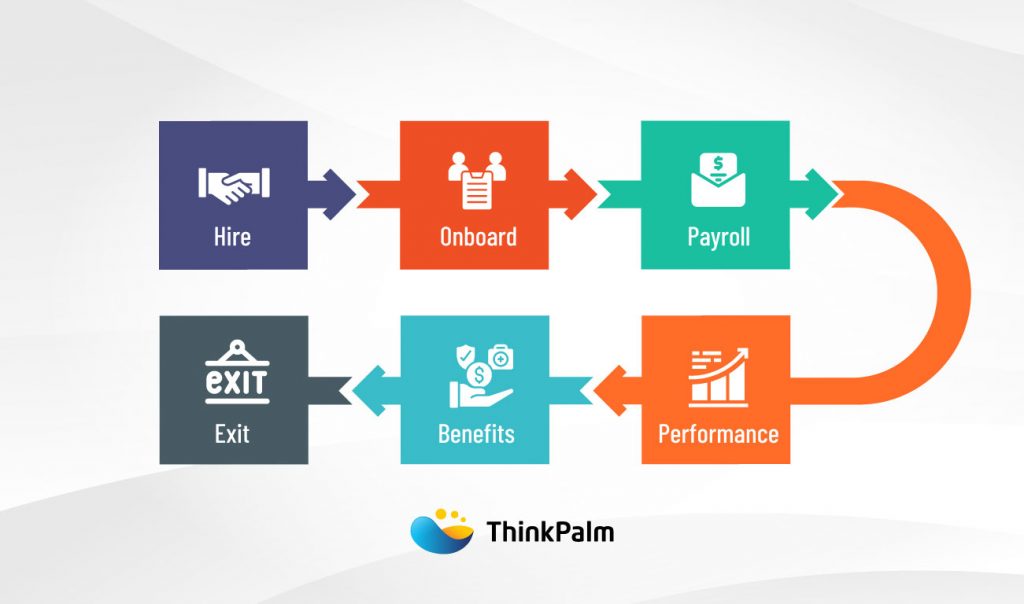
Employee lifecycle flow
Given that these platforms have several modules embedded in them from onboarding to payroll, performance tracking to analytics platforms, each integration could cause potential points of failures. What can be done to avoid this sort of crisis? There lies the need for HRMS Integration Testing and end-to-end HR and Payroll System Testing. This facilitates free flow of data and fosters business continuity.
Choosing the right HRMS testing partner is a strategic decision as it forms a crucial part of not just delivering smooth employee experiences but also meets compliance goals and financial operations.
An HRMS software that fails to meet expectations could frustrate HR teams, lose employee trust and even compromise all confidential data within the software. Therefore, companies need to opt for partners based on testing capability, domain depth, risk mitigation, compliance-ready security posture, and scalability.
Selecting a suitable HRMS partner is a critical decision to make. Since organizations are now using a platform that has evolved from mere transactional systems into more intelligent, decision support systems, there is a need for quality checking at every level of integration.
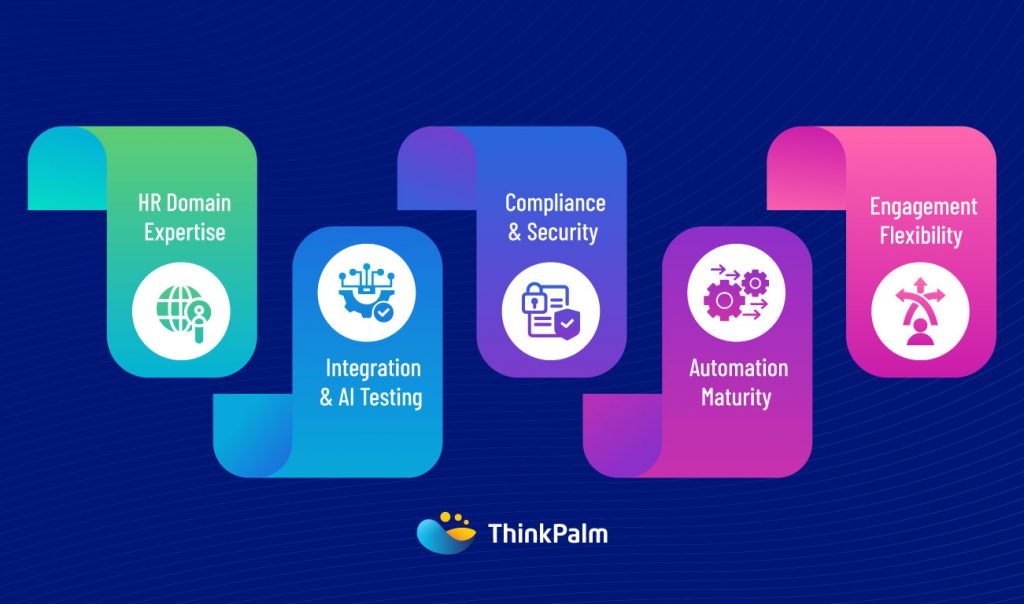
Factors for choosing the right HRMS testing partner
Listed below are certain crucial factors that will help you in guiding what buyers evaluate in RFPs and vendor shortlisting processes.
When selecting a suitable HRMS partner, companies prioritize vendors with demonstrated expertise in HRMS and HCM platforms. They particularly look for specific modules (payroll, time, benefits) in the course of their RFP processes.
A partner with deep HR domain knowledge, who understands payroll regulations, HR workflows and compliance requirements makes way for a well-designed HR Automation Testing Framework.
Specialized partners also bring pre-built testing playbooks, reusable test cases, and automation frameworks tailored for common HRMS platforms and industry-specific HR requirements.
A well-defined HR Automation Testing Framework designed by a testing partner will enable us to avoid risks in decision making as they clearly understand the nuances of Human resource management. This will cater to a smooth rollout and prevent compliance nightmares.
As payroll management is an essential pillar of a company, a partner with payroll system testing expertise and HRMS Integration Testing would provide several options and build test cases accordingly.
This reduces the learning curve, and companies can get started easily. Moreover, a partner that understands the same HR terminology can speed up the entire project, and teams can focus on their actual job.
The below-mentioned table will help you understand how a traditional testing partner is different from a specialized HRMS partner.
| Traditional Testing Partner | Specialized HRMS Partner |
| Learns HR terms during execution | Speaks “HR” from day one |
| Standard test scripts | Pre-built HRMS playbooks |
| High risk of compliance gaps | Payroll and compliance-first mindset |
| Limited understanding of HR workflows | Deep understanding of HR lifecycle and integrations |
Key takeaway: Deep HR domain knowledge directly impacts accuracy, compliance readiness, and faster implementation.
When choosing the right HRMS testing partner, you need to evaluate their ability to test complex integrations across interconnected business systems. An HRMS platform does not exist in isolation. There are several modules that are interconnected, and you must ensure that the system talks to each other. There may be modules for payroll, ERP, CRM, recruiting, and it is not just enough that these modules are tested independently. You need to ensure that data flows smoothly from end-to-end, i.e. from hire to retire.
A software that has AI features embedded in it must be tested suitably to assess:
Key takeaway: Integration failures are among the most common causes of HR transformation delays. Each unit needs to be tested separately for optimum results.
To see how AI is transforming HR workflows and automation strategies, read our blog on Agentic AI in Human Capital Management: The Future of Smarter HR Workflows .
As HRMS platforms manage crucial and sensitive personal data of employees, it is not about managing spreadsheets. This could include confidential information on bank details, health records, etc. While selecting a suitable HRMS testing partner, companies that securely handle such data can win the game.
Implementing masked or synthetic data strategies provides greater trust among platform users. Additionally, being familiar with compliance frameworks like GDPR, SOC 2 and HIPAA can win the trust of companies as it saves them from data breaches and financial penalties.
Moreover, providers that can support audit readiness and compliance reporting can gain a competitive edge in the market.
Key takeaway: Compliance failures can lead to financial penalties, reputational damage, and legal exposure. Vendors who contribute to successful audits and reduce compliance risks gain a competitive advantage.
When choosing an HRMS testing partner, organizations should evaluate their automation maturity and ability to integrate testing within modern development pipelines.
Manually testing each module is a time-consuming process. Therefore, leading partners choose updated means of undertaking testing strategies which are automated and capable of delivering the best results.
By implementing mature automation frameworks with self-healing scripts and CI/CD integration, teams can fix the minor UI changes maintaining automation across frequent releases. Moreover, this reduces the expenditure incurred upon ‘break-fix’ cycle that drains the budget.
Want to see automation in action? Check out how to apply these frameworks specifically to your ATS in our latest blog: How to Build Reliable, Error-Free Hiring Pipelines with Automated Testing .
Plugging in such automation elements into your development pipeline (CI/CD), provides continuous feedback every time a change is made. Hence, the platform evolves with frequent updates. This sort of quality assurance makes the testing strategies sustainable. Providers that can maintain automation even when the platform releases updates quite frequently are more likely to be a preferred choice during partner evaluation.
Strong HR Platform Quality Assurance automation improves long-term ROI.
Key takeaway: Automation maturity directly impacts release velocity, cost optimization, and sustainability.
Did you know?
Most data breaches in HR systems happen during the testing or implementation phase because “real” data is often used in unencrypted environments. Always ask your partner about their Data Masking strategy.
Companies are on the lookout for suitable partners that have the technical know-how as well as commercial practicality. Buyers value partners who can:
RFP guides say that cost predictability combined with delivery speed often determines final vendor selection.
Key takeaway: Cost predictability, engagement flexibility, and the ability to start and scale quickly often determine the final HRMS testing partner selection in RFP evaluations.
A successful HRMS roll out isn’t an easy task. It involves several parameters like staying on schedule, pricing factors, and above all safeguarding data. A suitable HCM software testing partner will enable us to gain competitive advantages as given below:
Very often, partners spend time learning about your business. However, the right partner is adequately prepared and brings along with them HR domain playbooks. A well-planned HRMS testing enables early detection of integration errors between your Payroll and ERP early. This stops last-minute disasters from crashing into your schedule.
A capable HRMS testing partner would implement automated testing that emerges as a cost-saver. By using self-healing scripts and CI/CD integration, the system can manage every update automatically.
For example: A quarterly platform release or a local tax change that gets tested automatically.
Consequently, this reduces the risk of expensive manual labor and prevents financial “leakage” caused by payroll inaccuracies or compliance fines.
Companies that adopt AI-enabled HR services into their workflows ensure you can innovate without fear. By testing AI bias, drift, and model precision, they allow your HR team to use features like talent recommendation engines or NLP chatbots with the confidence that these systems are fair, secure, and compliant with global standards like GDPR.
Therefore, AI-Powered HR Software Testing helps you check whether your AI is actually making accurate decisions for your employees.
Selecting a reliable HRMS testing partner is not just a technical checklist. But it’s a business strategy. At ThinkPalm, testing helps in enhancing the quality of your HRMS by streamlining processes directly affecting your compliance, workforce operations, and overall employee experience.
Moreover, companies that prioritize a structured testing framework can see immediate benefits in terms of faster rollouts, reduced risk, and scalability. However, traditional testing may not meet current business requirements. Now HR platforms have evolved to include predictive analytics and AI assistants. Therefore, testing partners must learn to handle not just “bugs”, but they need to validate the complex logic behind AI-driven decisions.
What’s Next?
Traditional HRMS testing is no longer enough. Learn why AI validation is becoming a critical factor when selecting an HRMS testing partner.
Explore the Next Blog →HRMS testing ensures that all modules within a Human Resource Management System such as payroll, recruitment, and performance management function accurately and securely. It is critical to prevent payroll errors, ensure compliance, and protect sensitive employee data.
To choose the right HRMS testing partner, evaluate their domain expertise, automation capabilities, compliance knowledge, integration testing experience, and ability to support AI-driven HR systems. A strong partner ensures reliability, scalability, and risk reduction.
Without proper HRMS testing, organizations may face payroll errors, data breaches, compliance violations, system downtime, and loss of employee trust. These risks can lead to financial penalties and reputational damage.
Automation accelerates testing cycles, reduces manual effort, and ensures consistent validation across frequent system updates. It also improves accuracy and helps maintain testing efficiency in CI/CD environments.
Effective HRMS testing improves system reliability, reduces operational risks, ensures compliance, and enhances employee experience. This leads to smoother HR operations and better decision-making.
Chandni Nadarajan is a content writer at ThinkPalm Technologies, specializing in B2B marketing content. With a passion for turning complex ideas into clear, engaging narratives, she blends strong research and storytelling skills to make technical topics accessible. Her expertise spans technology, automation, and digital business solutions.