Bridging the Digital Divide with 5G Fixed Wireless Access: Fiber-Like Broadband for Remote Homes and Businesses
Networking
 Neha Joy
August 20, 2026
Neha Joy
August 20, 2026



 Neha Joy
August 20, 2026
Neha Joy
August 20, 2026
Reliable internet has quietly become a basic utility, right up there with electricity and clean water. And yet, millions of homes and businesses, especially in rural and underserved regions, are still stuck with slow, unreliable, or overpriced broadband. Traditional wired infrastructure often can’t reach these areas because laying fiber or cable across long distances is expensive, slow, and sometimes just not worth it for a provider’s bottom line.
That’s the gap 5G fixed wireless access (FWA) is starting to close. By running broadband over existing 5G networks instead of physical cable, FWA can deliver fiber-like speeds without a single trench being dug. For telecom operators, enterprises, governments, and internet service providers, it’s turning into more than a nice-to-have. It’s a real strategy for expanding digital inclusion, moving faster on deployments, and opening up new revenue in markets that were previously too costly to serve.
Definition
5G fixed wireless access is a broadband technology that delivers internet to a fixed location, such as a home, office, school, or storefront, using wireless radio signals instead of fiber or copper cables.
Unlike mobile broadband, which is built for people on the move, fixed wireless broadband is designed for stationary sites. A nearby 5G base station talks to a piece of equipment installed at the customer’s premises, known as FWA CPE (Customer Premises Equipment).
The CPE picks up the wireless signal and shares internet access around the building through Wi-Fi or Ethernet, often through a self-install process similar to the kind of secure device onboarding used across other connected devices today.
You can think of it as “virtual fiber.” All the speed, none of the digging.
For network operators, fixed wireless access cuts deployment time dramatically and extends broadband coverage into areas where running wires simply doesn’t make financial sense.
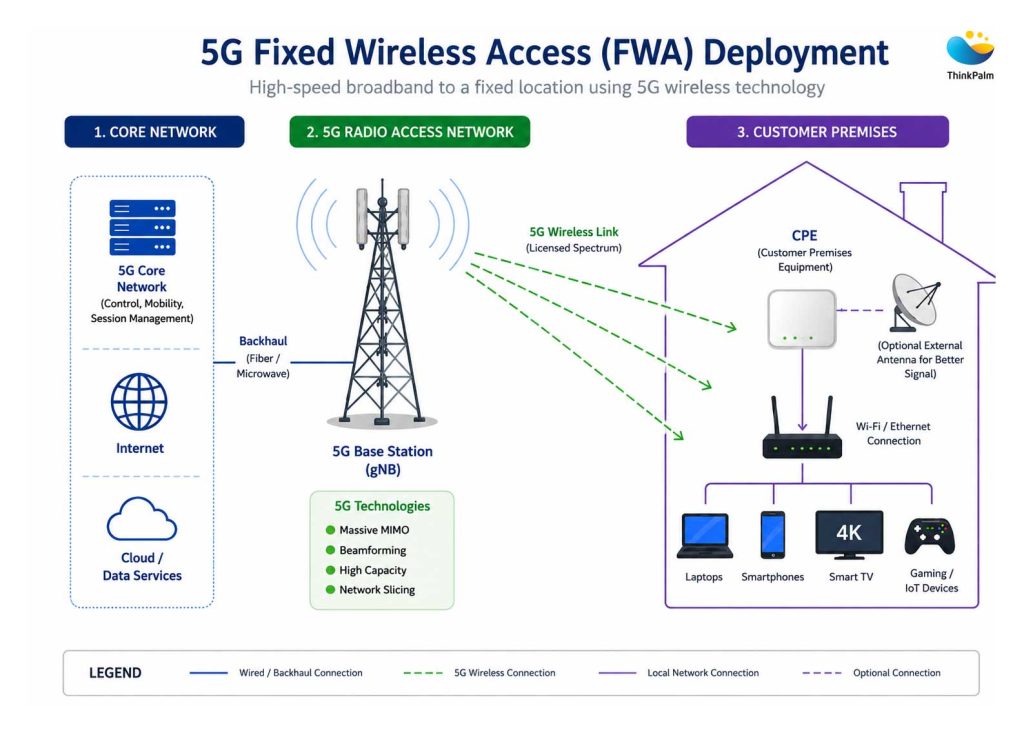
How 5G FWA delivers high-speed broadband to fixed locations.
In Simple Terms
If you’ve searched what is fixed wireless access and want the short version: it’s any broadband service that reaches a fixed address over the air instead of through buried cables. 5G fixed wireless access is just the latest, fastest version of that idea, built on 5G radio technology rather than older 4G LTE or point-to-point microwave links.
Broadband coverage has improved a lot over the past decade, but plenty of rural and semi-rural communities are still left out. A few reasons why:
At this point, unreliable broadband isn’t just an annoyance. For a lot of households and small businesses, it’s actively holding back economic opportunity.
The single biggest advantage of 5G FWA is how quickly it can be rolled out. Instead of months of construction, operators can extend service over 5G radio networks they already operate and get customer equipment installed in minutes rather than weeks.
Because fixed wireless access runs on wireless signals, there’s no need to dig up roads or bury fiber over long stretches. That alone shortens deployment timelines and reduces upfront capital costs.
Modern 5G FWA networks can approach download speeds of around 1 Gbps, which is enough for 4K streaming, video calls, remote work, cloud apps, smart home devices, and online learning. For most households, day-to-day use feels a lot like traditional wired broadband.
Running fiber to sparsely populated areas rarely pencils out financially. FWA lets operators reach those same customers using spectrum and radio infrastructure they already have in place, which is a far more cost-effective way to grow the business.
Most FWA connections use a plug-and-play CPE device that customers can install themselves, so broadband gets activated in minutes instead of waiting weeks for a technician visit. That’s a better experience for the customer and a lower cost to serve for the provider.
Simple setup matters everywhere in connectivity, including for the devices customers connect once that CPE is online. See how zero-touch Wi-Fi onboarding works for the devices on the other end of that connection.
The simplicity of fixed wireless broadband on the customer’s end hides a fairly sophisticated 5G architecture behind the scenes.
Older wireless signals spread out over a wide area, which wastes a lot of capacity. 5G solves that with Massive MIMO (Multiple Input Multiple Output) and beamforming, technologies that aim radio signals directly at the customer’s premises instead of broadcasting evenly in every direction.
The payoff shows up as:
This same targeting principle also shows up in wireless backhaul infrastructure, the high-capacity links that connect cell towers back to the core network. FWA essentially stretches that same focused, high-capacity wireless link all the way to a customer’s door.
ThinkPalm worked with a leading data communication company that designs and manufactures cellular backhaul equipment to help maintain and enhance their networking solutions. Read the case study to see how similar engineering expertise applies to wireless infrastructure like FWA.
5G also introduces network slicing, which lets operators split their network into virtual segments tuned for different jobs, such as residential broadband, enterprise connectivity, IoT traffic, or public safety communications. Each slice runs under its own quality-of-service rules, so heavy usage on one slice doesn’t necessarily drag down performance on another. That’s part of why FWA can stay reliable even during peak evening hours when everyone’s streaming at once.
When people weigh DSL vs satellite vs fixed wireless, 5G FWA usually wins on speed, latency, and how fast it can actually be installed.
| Feature | DSL | Satellite | 5G Fixed Wireless Access |
|---|---|---|---|
| Deployment Speed | Slow | Moderate | Very Fast |
| Installation Complexity | High | Moderate | Low |
| Latency | Moderate | High | Low |
| Typical Speeds | Low | Moderate | High (up to roughly 1 Gbps in good conditions) |
| Infrastructure Cost | High | High | Lower |
| Scalability | Limited | Moderate | High |
Versus DSL. DSL still runs over aging copper lines that struggle with today’s bandwidth-heavy apps. FWA delivers noticeably higher speeds without touching any of that old cabling.
Versus satellite internet. Satellite covers huge geographic areas, but it usually comes with higher latency, since the signal is traveling thousands of kilometers up and back. 5G FWA keeps latency much lower, which matters for video calls, online gaming, cloud computing, and anything that needs real-time responsiveness.
Versus fiber. Fiber is still the gold standard for raw performance and long-term capacity. But building it out to every last address is slow and expensive. FWA doesn’t try to replace fiber. It fills in the gaps fiber hasn’t reached yet, or won’t reach for years.
FWA isn’t a perfect fit everywhere, and it’s worth being upfront about that. A few things that can affect how well it performs:
Many FWA setups perform best with a relatively clear path between the customer’s antenna and the base station. Hills, dense trees, or tall buildings can weaken the signal.
Speeds may dip during peak hours or in areas where a lot of customers share the same base station.
Operators need enough licensed spectrum in a given area to support high-capacity FWA connections, and that varies by region.
In dense urban cores or for extremely high-bandwidth enterprise needs, dedicated fiber still tends to offer more consistent, higher-ceiling performance.
None of this makes FWA a bad option. It just means the best results come from realistic planning around coverage, spectrum, and expected usage, not treating it as a drop-in substitute for fiber in every scenario.
Want to know more about how spectrum availability affects wireless performance? Check out our blog on 6 GHz WiFi discovery to see how similar spectrum challenges play out in Wi-Fi networks.
Fixed wireless access solves real connectivity problems across a wide range of situations:
Reliable broadband means people can work from rural areas without giving up productivity, whether that’s video meetings, VPN access, cloud collaboration, or remote desktops.
Many SMEs need internet good enough to run cloud tools and transactions, but can’t justify the cost of a dedicated leased line. FWA offers faster deployment, solid uptime, flexible scaling, and lower installation costs.
Schools and students get access to online learning platforms, virtual classrooms, digital resources, and collaboration tools, even in areas fiber hasn’t reached.
Providers can expand telemedicine, remote diagnostics, and digital patient care into communities that have historically lacked reliable broadband.
New stores, pop-up locations, and temporary branch offices can get online fast, without waiting on a wired installation timeline.
Local governments are using FWA to support public Wi-Fi, smart surveillance, digital citizen services, and other connected infrastructure.
Beyond primary use, plenty of businesses run FWA as a backup connection, so operations keep running if their main fiber or cable link goes down.
For operators, FWA isn’t just another line item on the broadband menu. It’s a genuine growth lever. The business case usually comes down to:
Faster customer acquisition in markets that were previously out of reach
Better use of 5G infrastructure that’s already been paid for
Lower deployment costs compared to building out fiber
New revenue in underserved markets that competitors haven’t gotten to yet
A bigger subscriber base without the civil works that fiber requires
As 5G coverage keeps expanding, FWA gives operators a way to get more value out of the network they’ve already built, while finally reaching customers who’ve been underserved for years.
FWA has real advantages, but a successful rollout still takes some planning. Before deploying, it’s worth checking:
A little upfront planning goes a long way toward keeping performance consistent and getting real value out of the investment.
Analysts expect FWA adoption to keep climbing as 5G coverage expands, and businesses look for more flexible ways to get connected. Technologies like 5G Standalone (SA), more advanced beamforming, AI-driven network optimization, and smarter spectrum use should keep pushing performance, reliability, and service quality further.
FWA isn’t trying to replace fiber. It’s shaping up to be fiber’s practical partner, covering the ground fiber hasn’t reached yet, or may never reach economically.
Rolling out 5G FWA at scale isn’t just about having the radio spectrum in place. It takes dependable customer premises equipment, wireless software that’s actually tuned for real-world conditions, solid network management, smooth interoperability across devices, and rigorous testing before anything reaches a customer’s rooftop or windowsill.
That’s the piece ThinkPalm focuses on. With deep experience across 5G, telecom engineering, wireless software development, and broadband testing, the team works alongside service providers and technology companies to solve the engineering problems that come with building next-generation wireless broadband, whether that’s refining CPE firmware, hardening network equipment, or validating device performance before launch.
As more operators lean into FWA to reach underserved markets, having a partner who understands both the telecom side and the wireless engineering side make it easier to move fast without cutting corners on reliability. ThinkPalm is built to fill this gap by helping teams get products to market quicker, tighten up network and device performance, and build connectivity that actually holds up at scale.
Curious how reliability and performance actually gets validated? See how ThinkPalm’s Wireless Testing services help teams catch issues before devices ever reach a customer.
Explore Wireless Testing ServicesDemand for fast, reliable internet keeps growing across every industry and community, but the digital divide is still a real problem for millions of people. 5G fixed wireless access offers a genuinely practical way to close that gap. By pairing fiber-like performance with the flexibility of wireless deployment, FWA helps operators reach underserved markets faster, helps businesses get connected without the wait, and helps communities take part in the digital economy on equal footing.
For anyone planning a broadband expansion strategy, FWA isn’t an experimental technology anymore. It’s a proven option that speeds up digital transformation while cutting down on deployment complexity and cost, and with the right engineering partner like ThinkPalm behind the deployment, that transformation becomes a lot easier to deliver reliably.
Want to talk through your FWA deployment or engineering needs? Let’s discuss how we can help!
Neha Joy is a Tech Lead with 8 years of experience in Layer 2 and Layer 3 protocol development in C and python, with expertise in designing, developing and troubleshooting network protocols and systems. She is passionate about solving complex technical challenges and sharing practical insights from her experience in networking and software engineering. Outside of work, she enjoys reading and values keeping her home well-organized.