What is QSDC and How Does It Differ from Quantum Key Distribution (QKD)?
Networking
 Surya Sreekumar
March 9, 2026
Surya Sreekumar
March 9, 2026



 Surya Sreekumar
March 9, 2026
Surya Sreekumar
March 9, 2026
Have you ever wondered what would happen if someone intercepted an important message you sent online? In today’s digital world, concerns about hacking, data breaches, and encryption failures are becoming more common. As computing power grows and quantum computers emerge, traditional encryption methods may no longer be enough to protect sensitive information.
This is where Quantum Secure Direct Communication (QSDC) comes into the picture.
QSDC is part of modern Quantum communication protocols that use the laws of physics to keep data safe. Instead of using math-based encryption, it sends information through quantum states that show any sign of spying.
Researchers are now testing QSDC in real-world Quantum networking systems to make secure data transmission faster and stronger. As we enter the age of post-quantum security, QSDC is shaping the future of safe digital communication.
Read on to discover what QSDC is and how it stands apart from other quantum methods like QKD.
A Quick Overview
In this blog, you will learn what Quantum Secure Direct Communication (QSDC) is and how it enables secure message transfer without traditional key exchange. We explain how QSDC differs from Quantum Key Distribution (QKD) and why this difference matters. You will also explore its key features, telecom use cases, and real-world challenges. Finally, we look at how QSDC and QKD together can shape the future of quantum-secure telecom networks.
So, what is QSDC really all about? Quantum Secure Direct Communication (QSDC) is a method of sending secret messages directly through quantum channels without first exchanging encryption keys. It skips the usual step of creating and sharing a key first. You can think of it as sending a sealed quantum envelope that already contains the message inside.
The quantum encryption methods make it nearly impossible for anyone to copy or spy on the message without being caught right away.
Instead of depending on mathematical complexity (e.g. factoring or discrete logs), QSDC anchors its security in the axioms of quantum mechanics. No cloning, measurement disturbance, or superposition!
In secure quantum communication, the message itself is encoded into tiny particles of light called photons. If a hacker tries to listen in, those particles instantly change, alerting both the sender and receiver.
That’s how QSDC works in quantum communication! It keeps data safe from start to finish, creating a new way to protect our messages in the quantum world. This makes quantum information security much stronger than what we use in regular networks today.
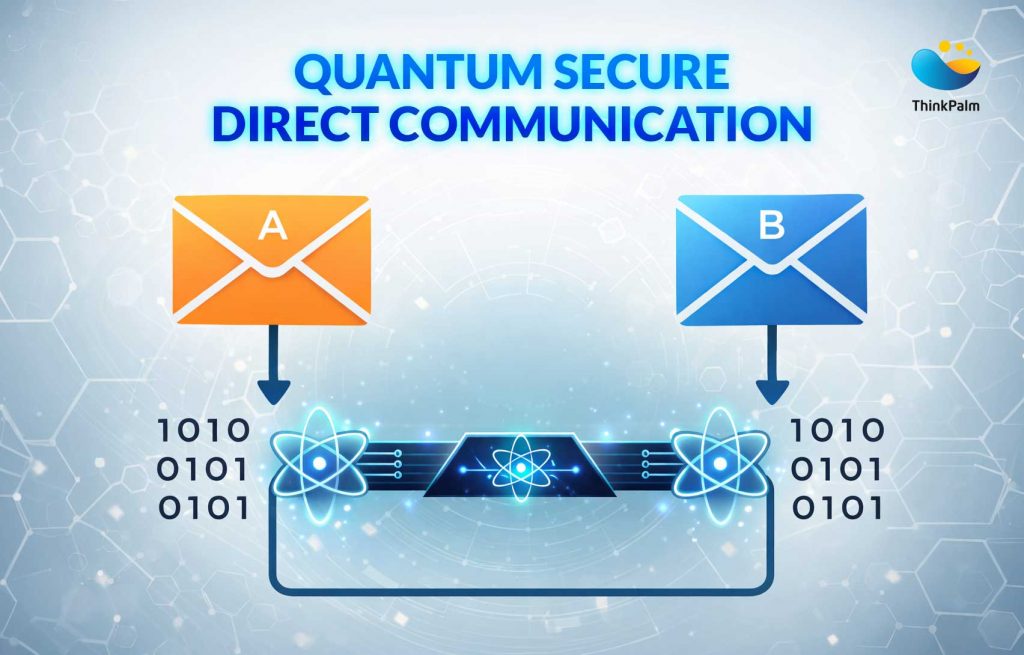
Quantum Secure Direct Communication enables secure data transfer between sender and receiver using quantum states.
So, what makes Quantum Secure Direct Communication (QSDC) so special for secure digital communication? Let’s break it down.
Interested in next-gen telecom network services? Discover how ThinkPalm’s Communication Services & Solutions can help you build secure and scalable networks today.
Let’s try to define Quantum Key Distribution (QKD). QKD is a smart way to share secret keys using quantum communication protocols. The mechanism is quite different. Instead of sending the actual message, it helps two people create a shared key that later locks and unlocks their data.
To understand it better, it would be ideal to know what is quantum cryptography and how does cryptography work. Like we talked about before, in quantum cryptography, information travels through photons. And, if someone tries to spy, these photons change, instantly warning both sides of the attack.
Once the key is safe, the real message is sent through normal channels using quantum encryption methods. This way, quantum key distribution keeps your communication secure without anyone stealing your secret.
Let’s take a closer look at how Quantum Secure Direct Communication (QSDC) works in real life. A QSDC setup might sound complex, but here’s what happens in simple steps:
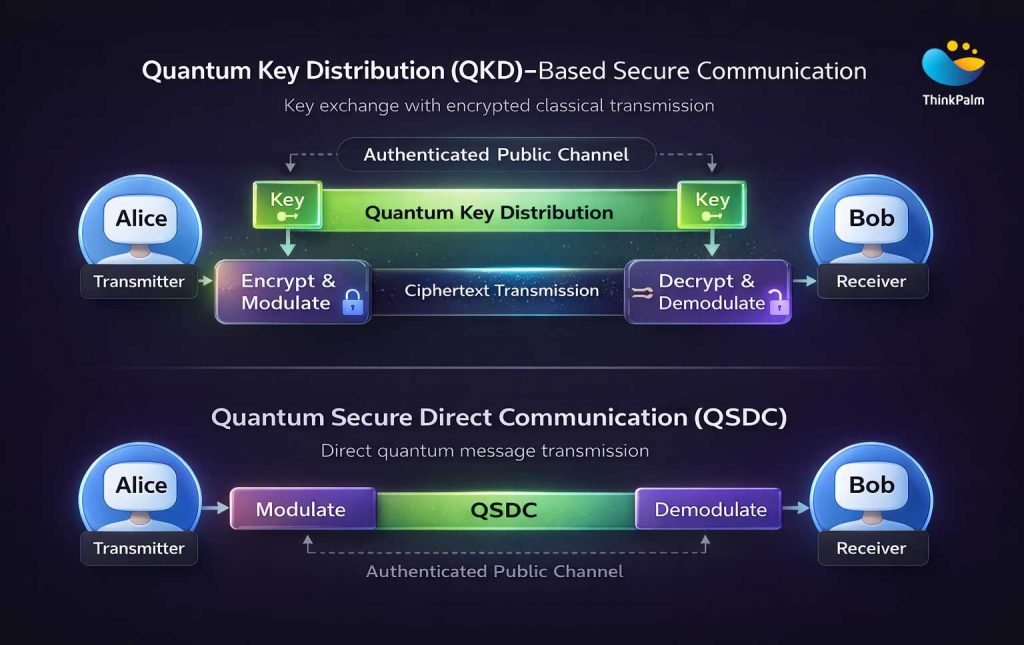
Comparison of QKD and QSDC showing key-based encrypted transmission versus direct quantum message communication between sender and receiver.
In a typical QSDC setup, Alice (the sender) changes her message into special quantum states and sends them over quantum channels to Bob (the receiver).
These quantum states travel as light particles, carrying the data safely across quantum networking systems.
Bob receives and measures these states to get the original message — no secret key is needed before this step.
They still use a normal (classical) connection to make sure no one tried to spy or change the data. Any eavesdropping would disturb the quantum states, alerting both sides.
QSDC allows for secure communication and data transmission of text, voice, or even video. It can also send encryption keys directly for even stronger quantum information security.
In short, QSDC makes quantum data transmission faster and safer by using the power of physics to keep messages truly private.
Many often get confused between QSDC and QKD, as both of them belong to the world of quantum security. But when knowing deeper, the difference between QSDC and QKD is quite obvious.
Here’s a quick QKD vs QSDC comparison in the table below.
| Aspect | QSDC | QKD |
| Transmission mode | Message carried on quantum states directly | Only the key is quantum; message is classical |
| Need for Pre-shared Keys | No separate key exchange or storage | Requires secure key generation, distribution, and management |
| Latency and Speed | Lower, since encryption is part of transmission | Higher, because message encryption follows key exchange |
| Security Level | Higher resistance to man-in-the-middle and quantum attacks due to direct transmission | Depends on secrecy of keys; vulnerable if keys compromised |
| Complexity | Simpler network structure—no key management overhead | Requires complex key management and distribution infrastructure |
| Capacity | Can utilize multi-dimensional quantum states for higher data capacity | Limited by key generation rates and classical transmission constraints |
| Application Suitability | Ideal for real-time, high-security telecom applications like TSN and industrial IoT | Suitable for secure key sharing across classical networks |
Telecom networks are capable of handling tons of calls, messages, and data across the world. But keeping that data safe is becoming harder every day. With Quantum Secure Direct Communication (QSDC), you can ensure safety. Apart from being just another tech term, it could change how we protect our information and data forever.
Now let’s take a look at why QSDC matters for the telecom industry:
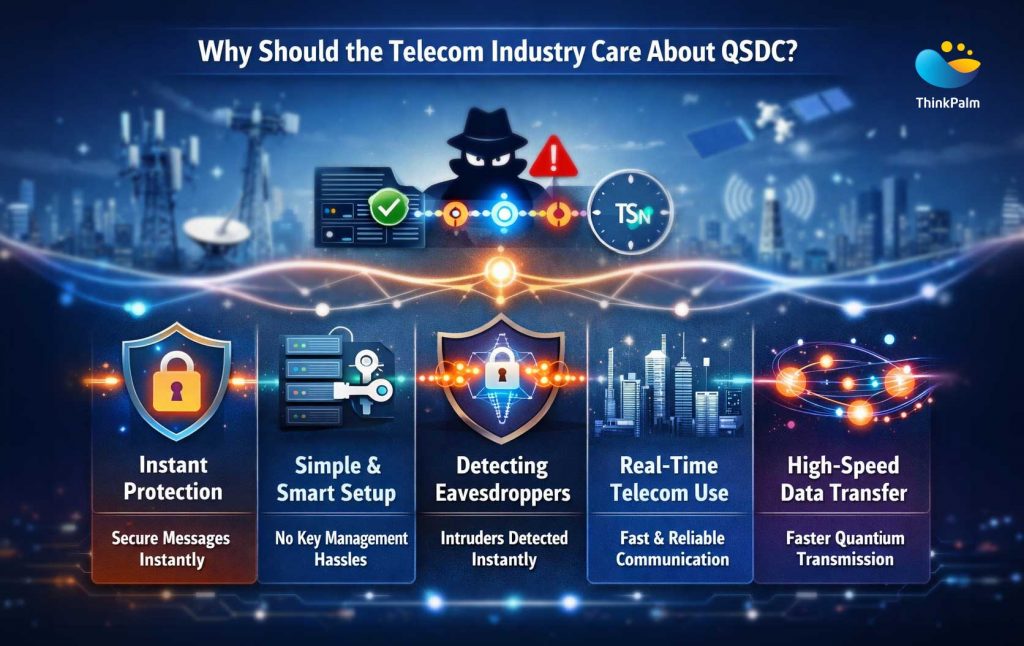
Why QSDC is critical for telecom, enabling instant protection and secure high-speed communication.
QSDC provides instant protection. Your message is secure at the moment it’s sent. It builds security right into the message using quantum communication protocols. That means faster and more secure quantum communication.
No more worrying about creating, storing, or refreshing keys. QSDC makes systems easier to manage and reduces the chances of mistakes that could cause data leaks.
If anyone tries to snoop, the quantum particles instantly change, warning both sides that something’s wrong.
In Time-Sensitive Networks (TSN), every millisecond counts. Since QSDC skips long key exchanges, it helps keep calls and data running smoothly without delays.
By using advanced photon and entangled-state methods, QSDC could send more data faster than ever before.
As advancements in QSDC continue, the telecom industry has a big reason to care. It’s the next step toward truly unbreakable communication and a safer, smarter connected world.
As telecom networks prepare for quantum-safe communication, core network protocols must evolve as well. Explore why L2 and L3 testing needs a rethink in the AI and quantum era in our blog on the future of network protocol testing .
So, where can Quantum Secure Direct Communication (QSDC) actually make a difference? The answer is almost everywhere in telecom. From mobile networks to satellites, QSDC and quantum networking are changing how we protect information.
Here’s how it helps:
In simple words, QSDC is moving from science labs into real telecom networks. It shows how quantum networking can make our connected world faster, safer, and ready for the future.
Explore how IoT-driven insights are empowering telecom providers to make data-backed decisions and deliver seamless connected experiences.
Quantum Secure Direct Communication (QSDC) sounds like the future of safe communication, right? But before it becomes part of everyday telecom, there are a few bumps on the road. Let’s take a look at what’s holding it back.
The journey toward advanced telecom networks does not stop with quantum innovation. Reliable connectivity depends on robust testing frameworks. Explore how wireless device testing plays a key role in building secure and efficient wireless ecosystems .
The next step in quantum telecom is bringing Quantum Secure Direct Communication (QSDC) and Quantum Key Distribution (QKD) together. This hybrid quantum communication approach uses QKD to create secure keys and QSDC to send data safely without them.
By working side by side, they can build stronger, faster, and quantum-resistant communication networks, shaping the future of post-quantum security.
The way we send and protect data is evolving every day, and Quantum Secure Direct Communication (QSDC) is leading the way. Built on the principles of quantum mechanics, it takes data security beyond traditional encryption algorithms and digital signatures.
As the quantum internet grows, QSDC can work hand in hand with optical fiber networks and QKD protocol systems to create faster, safer communication.
Want to make your telecom network smarter and more secure? Talk to ThinkPalm’s telecom experts to see how our solutions can help you move toward a quantum-secure future.
Quantum communication uses the principles of quantum mechanics to share data safely across a QKD network, ensuring that any eavesdropping attempt is instantly detected.
It’s far more secure than traditional methods because its protection doesn’t depend on computing power. Any interception changes the quantum state, warning users right away.
Quantum cryptography encodes cryptographic keys into quantum particles like photons. These keys can’t be copied or measured without altering their state, keeping the data safe.
Surya Sreekumar is a seasoned Technical Lead with 10+ years of industry experience in the telecom domain. Her role involves guiding development teams, resolving critical technical challenges, and ensuring scalability, performance, and reliability of telecom platforms. She is also passionate about mentoring engineers and driving best practices across teams.