Key Insights from an AI Software Development Case Study in Payroll Software
Software Development
 Chandni Nadarajan
July 2, 2026
Chandni Nadarajan
July 2, 2026



 Chandni Nadarajan
July 2, 2026
Chandni Nadarajan
July 2, 2026
“When a market-leading UK payroll and HR software provider set out to raise the bar on what their platform could do, they came with a clear ambition: deliver faster, with higher accuracy, on a foundation built to scale with them for years to come.”
They weren’t starting from zero. They had a strong product, an established client base, and deep domain expertise. What they wanted was a payroll platform transformation that would compress timelines without compromising the precision that payroll software demands.
That’s where ThinkPalm came in. This blog post covers about the application of AI in software development and how intelligent automation is embedded across every phase of the software development lifecycle. From requirements through testing, ThinkPalm helped the client achieve something remarkable: 50% faster delivery, meaningfully reduced errors, and a modular architecture built to evolve alongside their business.
Payroll is one of the most demanding domains in enterprise software. Rules change by contract type. Compliance shifts with every new regulation. Every edge case that slips through testing doesn’t just cause a bug, it affects real people’s pay.
For any team building in this space, the challenge isn’t just writing code, it’s making sure that every requirement is properly understood, every module is thoughtfully designed, every logic path is tested, and every release is production-ready. In traditional development, achieving all of that at speed requires significant investment of both time and manpower.
The growing role of AI in software development has opened a new way to approach this not by adding more people, but by embedding intelligence into the process itself.
ThinkPalm’s Approach
An AI-First SDLC model is an approach to software development where intelligent automation is embedded across every phase of the lifecycle. This AI software development case study puts that model into practice from requirements elicitation through to testing instead of adding AI as a single tool at the end. This means each phase is designed to work with AI assistance so that every phase moves faster, smarter, and with greater confidence than traditional development could deliver.
ThinkPalm’s approach to the Automated HR/Payroll (AHP) platform wasn’t a one-time fix. It was a systematic layering of intelligent assistance through each stage of development. Here’s exactly how each phase was transformed.
Key Principle
This is the defining difference between traditional SDLC and ThinkPalm’s AI-first execution model.
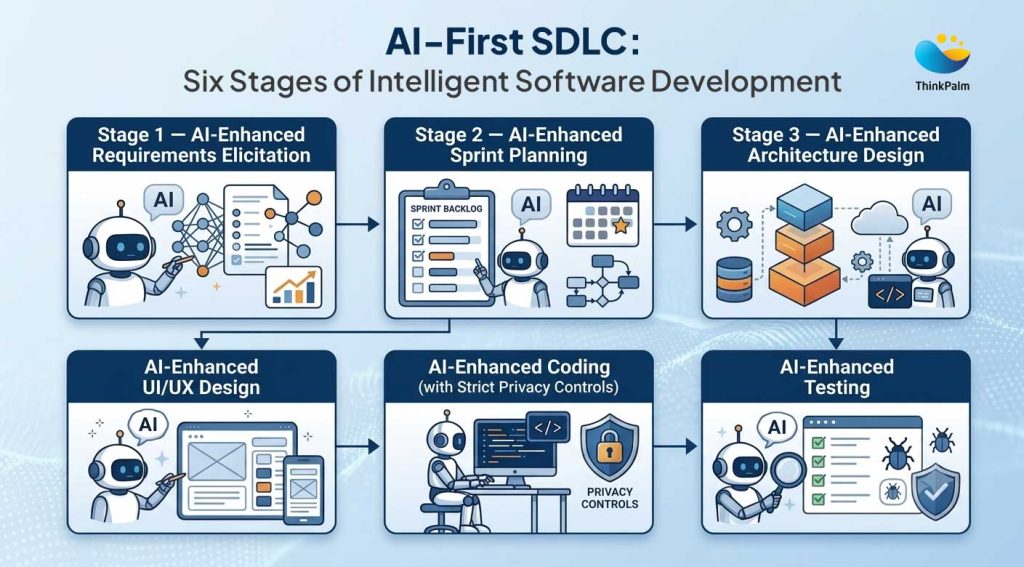
A step-by-step breakdown of AI in software development
Most software projects invest heavily in requirements gathering, and rightly so. In payroll, the cost of ambiguity discovered late is especially high – a missed compliance rule or an edge case in calculation logic can ripple across an entire client base.
ThinkPalm applied AI at the requirements stage itself to raise the bar on precision.
To explore how autonomous AI agents approach requirements elicitation more broadly, see how Agentic AI automates every SDLC phase.
With strong requirements in hand, the next challenge was converting them into a sprint structure that teams could execute without constant re-sequencing. ThinkPalm used AI to remove the friction from backlog creation entirely.
In a domain like payroll, today’s architecture is tomorrow’s constraint or tomorrow’s competitive advantage. Payroll rules vary by type (fixed, variable, accrual, zero-day), change with regulations, and need to connect with an ever-changing ecosystem of HR platforms.
With the architecture validated, the payroll platform transformation moved from blueprint to build, and AI continued to lead the way.
Design-to-development handoffs are typically where time and intent both get lost. Developers interpret designs. Gaps appear. Iterations multiply. ThinkPalm used AI in software development to close that gap from the start.
ThinkPalm’s engineering experts can walk you through how each stage of your development lifecycle could be accelerated with the right AI model.
This is where the cumulative impact of the AI-first model became most visible in day-to-day delivery. Payroll business logic was first prototyped in Python with AI assistance validating rules and assumptions quickly and cheaply before committing to .NET implementation.
🔒 Code Privacy
Privacy-enabled configurations ensured client code was never exposed to third-party model training. Confidentiality was a non-negotiable part of the AI-assisted development process.
Payroll systems demand rigorous testing. A missed edge case in a tax calculation or a rounding error in an accrual isn’t an inconvenience it’s a compliance event. ThinkPalm in its AI implementation case study applied AI to generate test coverage that matched the complexity of the domain.
Exploring the results behind this engagement? Read how ThinkPalm delivered 50% faster payroll implementation with AI in the full case study.
Across this AI software development case study, the cumulative effect of AI-assisted development added up to a step change in delivery performance. These next-generation capabilities reflect a broader shift of how Agentic AI is transforming payroll management and enabling intelligent automation across payroll workflows. Here’s what the client saw:
| Delivery Area | Impact |
|---|---|
| Requirements Phase | Improved structure, completeness, and fewer downstream change requests |
| Sprint Planning | Faster backlog creation with cleaner dependency management |
| Coding Cycles | Shorter cycles and meaningfully reduced defect rates |
| Test Coverage | Broader, earlier coverage with fewer post-deployment issues |
| Overall Delivery | ~50% faster compared to traditional SDLC |
Beyond the delivery numbers, the client came away with a clean, modular platform built on validated architecture and a renewed position as an innovative leader in payroll and HR software.
ThinkPalm’s roadmap for this AI implementation case study extends the AI-first model into the operational layer. The next wave of intelligent automation being planned includes:
Automated deployment health monitoring and rollback capabilities reduce manual intervention and downtime during software releases, enabling faster and more reliable delivery.
AI identifies payroll variances and compliance risks before payroll runs, giving operations teams the visibility to resolve issues proactively instead of reacting after processing.
Employees receive accurate, instant answers to payroll questions through AI-powered chatbots, reducing HR support workloads and improving the employee experience.
The platform continuously learns from every payroll cycle, improving accuracy across payroll rules, compliance requirements, and complex edge cases over time.
The next generation of AI in software development will not be defined by how many developers are on a team, but by how intelligently AI is embedded into how that team works.
ThinkPalm’s AI software development case study in the Automated HR/Payroll platform demonstrated that intelligent automation applied across the SDLC, not just at a single stage, compounds across every phase of delivery. Cleaner requirements feed better sprints. Better sprints feed cleaner code. Cleaner code feeds faster, more confident testing. And the whole cycle delivers results that neither the timeline nor the quality must compromise.
This end-to-end approach also shows how AI enhances manual testing, enabling QA teams to focus on high-value validation while AI handles repetitive testing tasks.
The same model applies across telecom, logistics, fintech, manufacturing, and enterprise software. Wherever complex software is being built, the teams moving fastest today are the ones that have made AI a collaborator, not an afterthought.
ThinkPalm combines deep engineering expertise with a proven AI-first model to help you accelerate delivery, reduce defects, and build platforms that scale. Let’s identify where the biggest gains are in your SDLC.
Chandni Nadarajan is a content writer at ThinkPalm Technologies, specializing in B2B marketing content. With a passion for turning complex ideas into clear, engaging narratives, she blends strong research and storytelling skills to make technical topics accessible. Her expertise spans technology, automation, and digital business solutions.