Industrial IoT Gateway Solution for Secure BLE-to-Cloud Integration
Industrial Internet of things (IIoT)
 Aparna Ajith
February 11, 2026
Aparna Ajith
February 11, 2026



 Aparna Ajith
February 11, 2026
Aparna Ajith
February 11, 2026
Industrial systems are becoming more connected every day. Be it in factories, warehouses, and other facilities, sensors are widely used to measure temperature, track equipment, and monitor conditions. But collecting data from sensors is only the first step. To be useful, this data must reach the cloud in a safe and reliable way.
An industrial IoT gateway solution makes this possible by gathering sensor data, managing connectivity, and securely transmitting information to cloud platforms. Read on to understand how this industrial IoT gateway solution gives teams better visibility, faster access to data, and the ability to manage devices remotely.
What’s in this blog!
In this blog, we explain how industrial IoT gateways enable BLE sensor networks to connect to the cloud, explore ThinkPalm’s BLE-to-Cloud gateway approach built on NetvirE, and highlight real-world use cases across industrial and retail environments.
An industrial IoT gateway solution is a system that connects industrial devices to the cloud. To put it simply, it collects data from sensors, machines, and controllers, and then sends that data securely for storage, monitoring, and analysis.
An IIoT gateway works as the middle layer between the physical world and digital systems. On one side, it talks to sensors and equipment using local networks. On the other hand, it communicates with cloud platforms using secure internet connections. This setup helps keep devices organized and data flowing smoothly.
Explore how NetvirE supports practical IIoT deployments to address real industrial challenges in our overview of the NetvirE IIoT platform.
In industrial environments, Bluetooth Low Energy Gateway sensors are designed to be lightweight and power efficient, not cloud-connected. A BLE-to-cloud gateway aggregates sensor data, centralizes security and connectivity, and reliably transfers information to cloud platforms—simplifying large-scale deployments while keeping sensors low power and easy to manage.
With this foundation in place, let’s look at how ThinkPalm implements industrial BLE to cloud integration using a purpose-built edge gateway and the NetvirE IIoT platform.
ThinkPalm’s BLE–to–Cloud gateway is a ready-to-use edge solution built on the RA6W2 MCU. It is customized at the firmware level to coordinate BLE 5.0 sensor networks and support secure connections to the cloud.
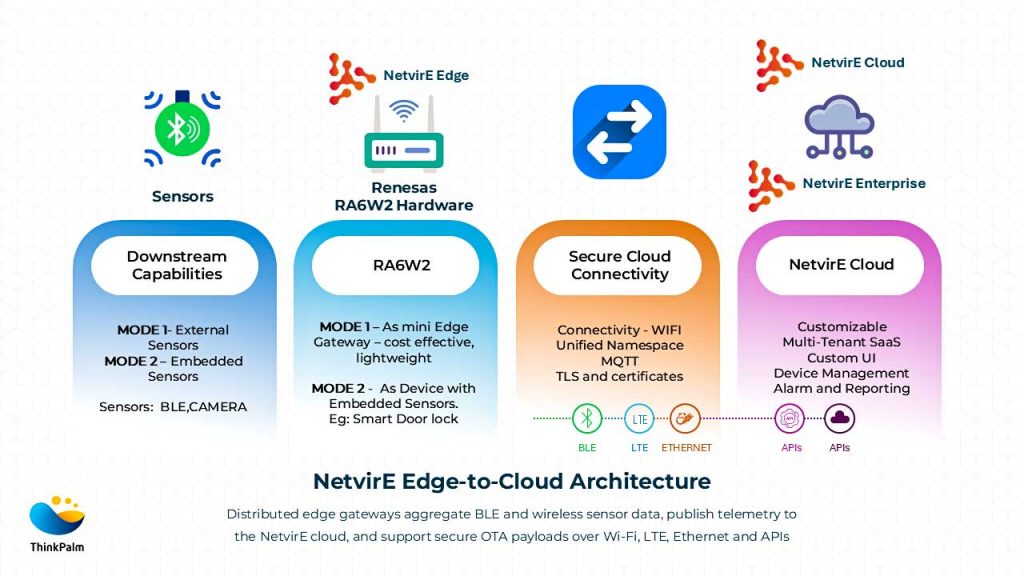
Architecture overview of the NetvirE Edge-to-Cloud system.
Data from multiple BLE sensors is collected by RA6W2. The data is then organized into cloud-ready messages and securely synced bi-directionally with the NetvirE IIoT platform. Information moves in both directions using encrypted, industry-standard protocols, allowing updates to reach the cloud and return to the gateway when needed.
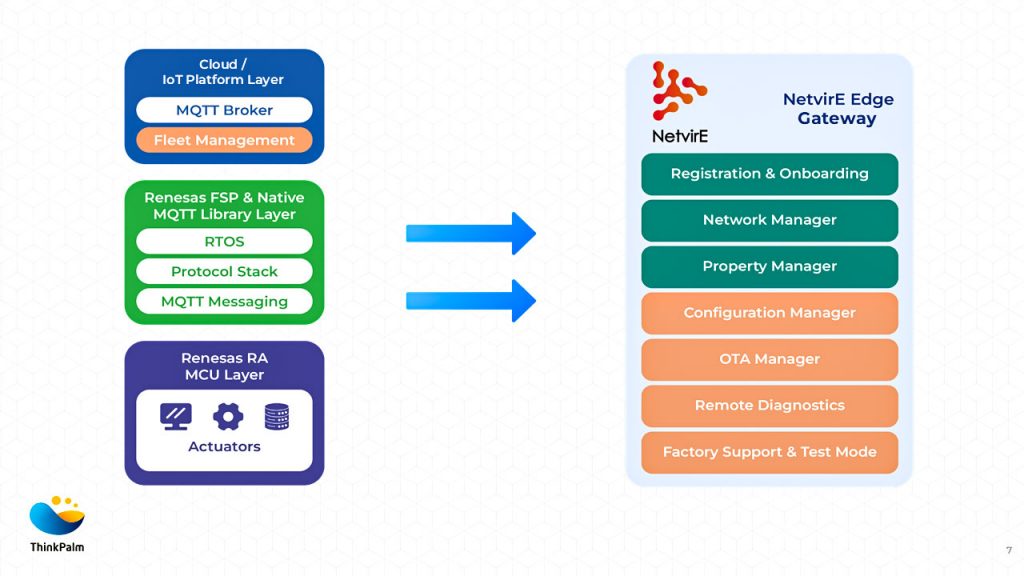
A detailed architectural diagram of the NetvirE Edge Gateway software stack.
The RA6W2 MCU acts as the gateway and runs all local communication layers directly in firmware. It does not need any external processors. The gateway manages BLE sensing, Wi-Fi connections, MQTT message structuring, secure device setup, and over-the-air (OTA) updates execution as internal device layers.
The Property Manager keeps site and device settings consistent across deployments. A Network Manager controls how interfaces connect and stay online. Together, these layers make the gateway reliable and easy to manage in real-world environments. This design helps teams avoid custom software, reduce integration risks, and deploy scalable IIoT gateways with confidence.
The NetvirE Cloud then consumes structured data from the gateway and uses it for analytics, visualization, and fleet-level insights. It can also send configuration changes or software updates back to the same RA6W2 edge device for local enforcement.
NetvirE includes a real-time dashboard that shows sensor activity, data trends, and system alerts in one place.
Here’s what this setup delivers in real deployments:
The RA6W2 combines Wi-Fi 6 and BLE 5.0 on a single ARM Cortex-M33 core. This allows it to handle IoT and gateway tasks without the need for extra processors. For industrial edge systems, this means fewer components, lower hardware cost, and reliable performance in real-world conditions.
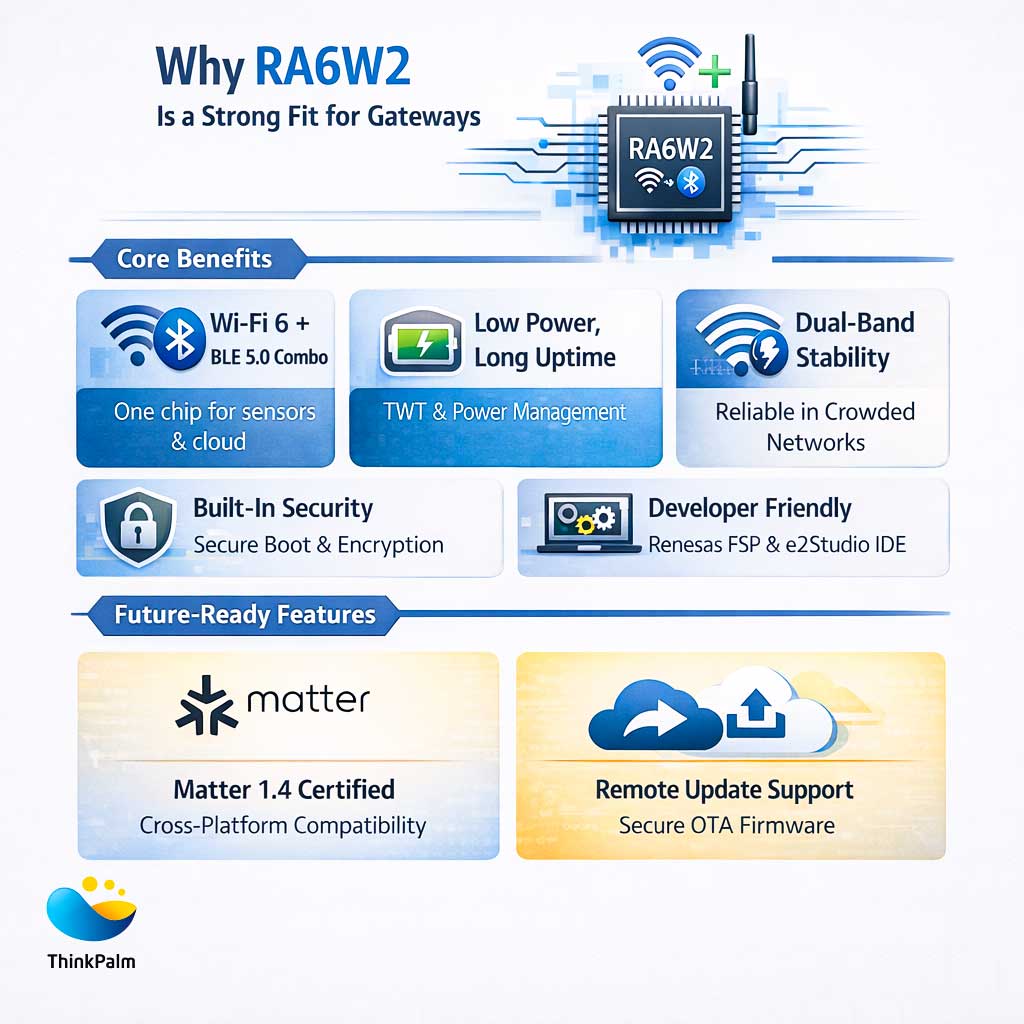
A technical specification overview of the RA6W2 MCU.
NetvirE is ThinkPalm’s cloud-native IIoT platform built for fast, secure, and scalable industrial deployments. It supports BLE to cloud integration by moving BLE sensor data to cloud systems, acting as a central control layer. Using BLE to MQTT cloud integration, NetvirE turns edge data into real-time insights, remote control, and fleet-level visibility.
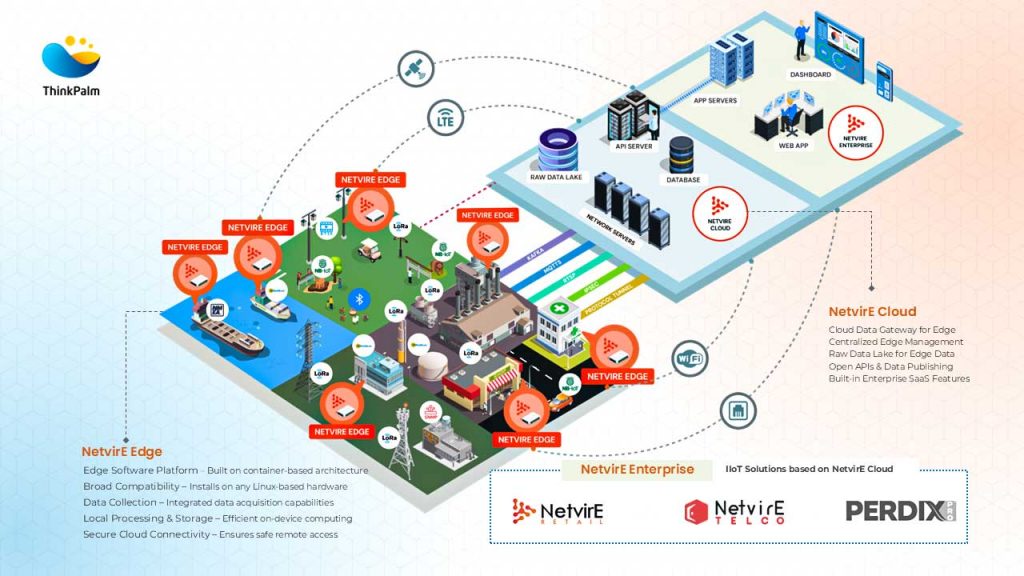
NetvirE Edge–Cloud Data Flow: The architecture supports multiple connectivity paths (Wi-Fi, BLE, LTE, Ethernet, and cloud APIs), allowing sensor data and gateway telemetry to flow securely from edge nodes to NetvirE Cloud for processing and OTA orchestration.
NetvirE provides the cloud intelligence that complements edge gateways and simplifies large-scale BLE deployment. As a comprehensive BLE to cloud integration solution, NetvirE offers seamless BLE gateway to cloud integration that removes the complexity of managing distributed sensor networks.
Here are some of the ways in which NetvirE helps in BLE-to-Cloud gateway solution:
NetvirE also includes GPS-based site tracking, offering a real-time map of deployed gateways. This allows teams to quickly locate devices, check site status, and access key details through interactive maps—while keeping BLE sensors securely isolated behind the gateway.
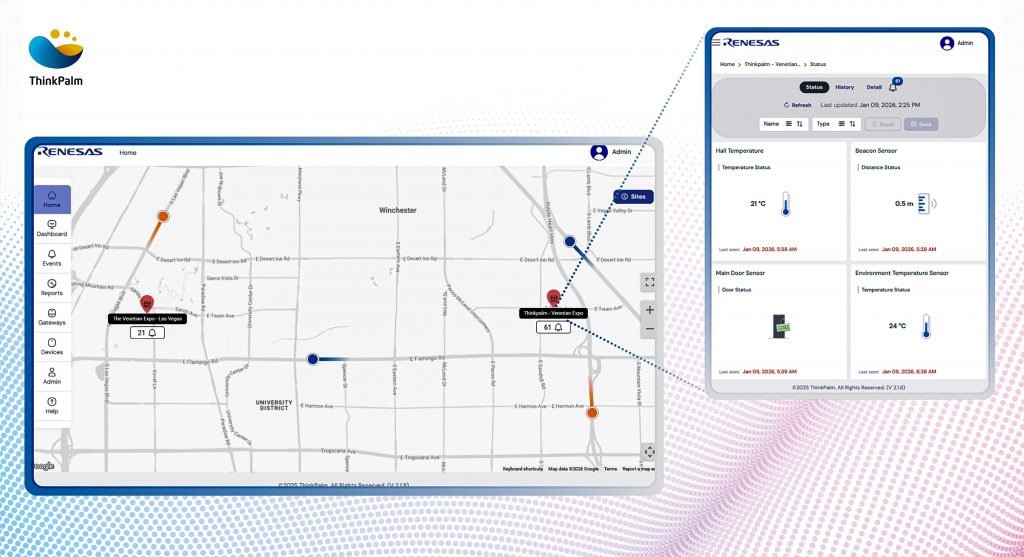
The ThinkPalm NetvirE cloud dashboard providing real-time, high-level overview.
Learn how cloud dashboards and edge devices on the NetvirE IIoT Platform enable real-time monitoring in remote conservation areas.
Read the Case StudyBLE to cloud integration helps show how sensor data moves from the physical world to digital systems in real time. In real environments, BLE-to-cloud gateways collect data from nearby sensors and securely send it to the cloud. This makes it easy to monitor conditions, track changes, and respond quickly. The following demo use cases show how this works across different settings.
Imagine a busy retail store on a weekend. Customers are walking through aisles, doors open and close all day, and the store temperature needs to stay just right. Keeping track of all this manually is hard and slow.
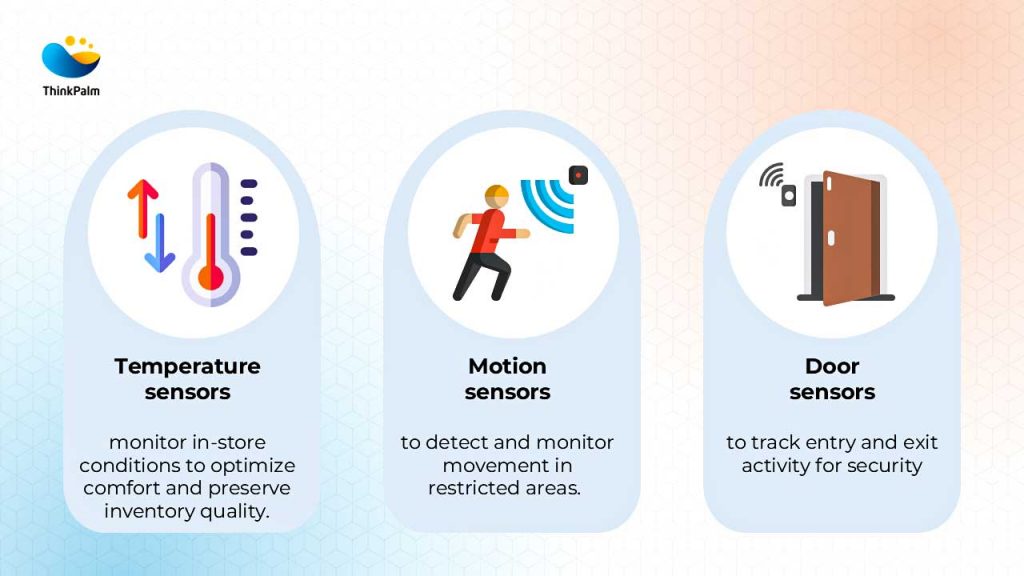
Overview of specialized IoT sensors supported by the NetvirE ecosystem.
With a BLE-to-Cloud gateway in place, small BLE sensors are installed across the store.
All these sensors send their data to a single BLE gateway. The gateway then securely sends this information to the cloud, where it appears on live dashboards. This allows the store teams to see what is happening in real time, even if they are not inside the store.
In the end, the store becomes more aware, more responsive, and easier to manage. Instead of just collecting data, the system helps retail teams act faster and make smarter decisions every day.
In big industrial and enterprise spaces, monitoring is not simple. Think of factories, warehouses, or large office campuses. This is where industrial and enterprise monitoring at scale becomes essential, as these environments can have hundreds or even thousands of sensors running at the same time. To manage all of this smoothly, teams need a strong industrial IoT gateway solution.
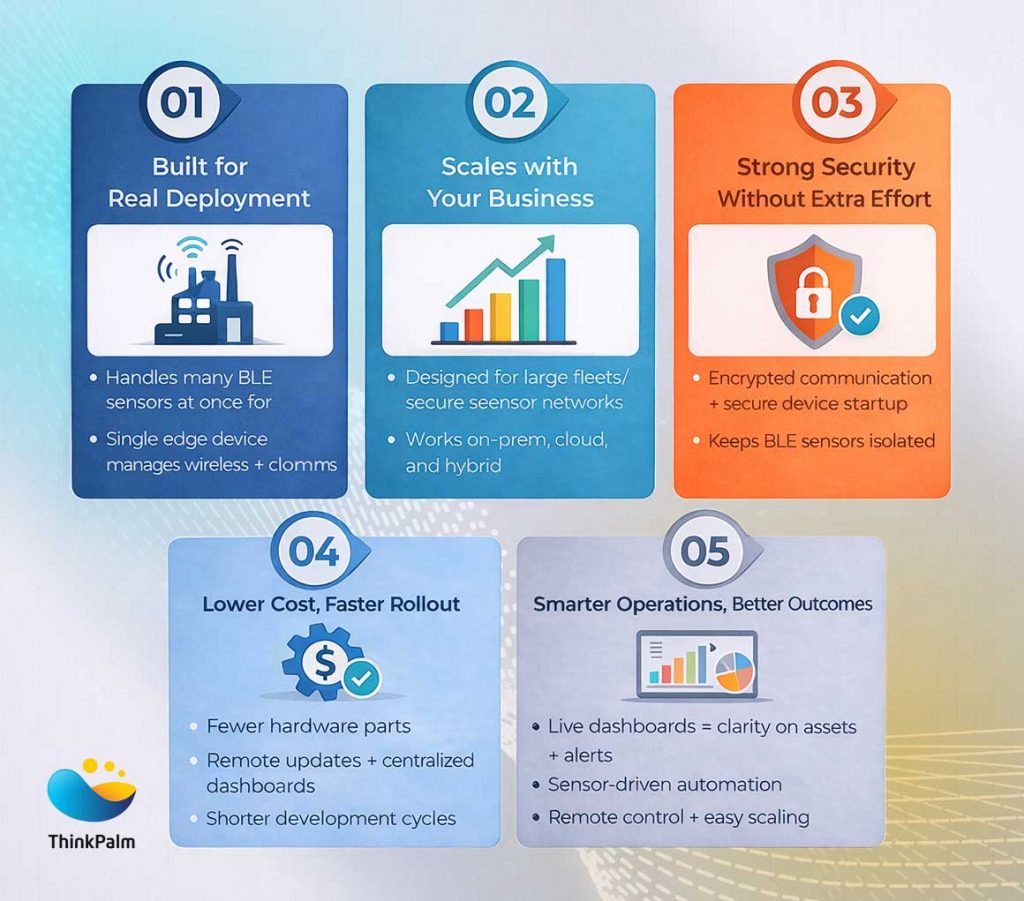
Five core business advantages of the NetvirE platform.
Let’s take a simple example. Imagine a large factory with many machines. Temperature sensors watch for overheating, vibration sensors check machine health, and door sensors track restricted areas. The gateway sends all the data from these sensors to the cloud, where teams can see live updates on dashboards and get alerts when something looks wrong.
With remote updates and central dashboards, teams spend less time on manual work and more time fixing real issues. In the end, this approach helps teams stay in control, respond faster, and manage large operations with confidence.
See how NetvirE supports large-scale infrastructure management for telecom networks with centralized monitoring and remote control.
Read the Case StudyChoosing the right BLE gateway for industrial use means looking beyond basic hardware. A strong industrial IoT gateway should support reliable edge processing, secure data transfer, and a flexible edge-to-cloud BLE integration architecture. Most importantly, it should work with different edge computing platforms so deployments are not locked into one hardware option as technology evolves.
This is where ThinkPalm brings real value. ThinkPalm’s NetvirE platform is designed to integrate with a wide range of edge computing controllers that support BLE and cloud connectivity. Whether the gateway uses one wireless MCU platform or another with similar capabilities, NetvirE enables the same secure BLE sensor data to cloud flow. This hardware-agnostic approach gives teams the freedom to choose the right edge platform while relying on ThinkPalm’s proven architecture for scalable, industrial-grade deployments. The result is a proven BLE to cloud integration solution that scales with your operations.
An industrial IoT gateway solution plays a key role in turning sensor data into real business value. With the right design, it connects BLE sensors to the cloud in a secure and reliable way, without adding extra hardware or complexity. This makes BLE to cloud integration easier to deploy and simpler to manage at scale.
By combining edge intelligence with cloud visibility, businesses can monitor operations in real time, respond faster to issues, and grow their deployments with confidence. If you’re looking to build or scale a secure BLE-to-cloud system, ThinkPalm can help you design the right gateway architecture and bring it to life.
An industrial IoT gateway acts as a bridge between sensors, machines, and the cloud. It collects sensor data, manages device connections, and securely transmits information to cloud systems. This improves system scalability, enhances security, and simplifies industrial IoT deployments.
Most BLE sensors cannot connect directly due to limited processing power and energy constraints. An industrial IoT gateway handles communication between BLE sensors and cloud systems, ensuring secure, reliable, and scalable integration.
ThinkPalm’s solution uses the RA6W2 MCU as a secure edge device that collects BLE sensor data, structures it for the cloud, and communicates with the NetvirE platform. It enables live dashboards, remote device updates, and centralized monitoring—all without extra hardware.
ThinkPalm’s approach uses end-to-end encryption, network isolation, and secure MQTT protocols. Sensors do not connect directly to the internet, reducing exposure to cyber threats.
Aparna Ajith is a Software Engineer at ThinkPalm Technologies, working on BLE and Wi-Fi connectivity solutions for IoT systems. Her focus areas include embedded networking, Linux device drivers, and building reliable gateway software for secure edge-to-cloud communication.