I3C vs I2C: Understanding the Key Differences and Why I3C Is the Future
Networking
 Padmapriyan R
December 4, 2025
Padmapriyan R
December 4, 2025



 Padmapriyan R
December 4, 2025
Padmapriyan R
December 4, 2025
When we talk about how chips and sensors communicate inside a device, we usually think about serial communication protocols. These protocols act like mini roads that enable various components of a system to share data.
Over the years, people have used the I2C protocol since it is low cost and easy to use. It also supports simple communication between sensors and controllers very well. However, with the increasing speed, smarter and more connected devices, I2C was falling behind.
This is where the I3C protocol comes in. It keeps the simple format of I2C and increases its speed and power efficiency. Moreover, it adds new features that modern devices typically need.
Due to this fact, the I3C vs I2C comparison is more crucial than ever for engineers involved in the creation of next-gen products.
In this blog, we explore how I3C improves on I2C and why, in the long run, many systems are now moving toward I3C for future-ready designs.
At first, the popularity of the I2C protocol grew because of its simplicity and low cost. Additionally, it required only two wires to operate sensors and chips.
As a result, this made it easy for people to add multiple devices to the same bus.
However, over time, it became the default option for basic communication in most electronics.
But, as systems became more complex, I2C began to reveal its limitations. Consequently, this led to more interest in newer options and clearer I2C vs I3C differences.
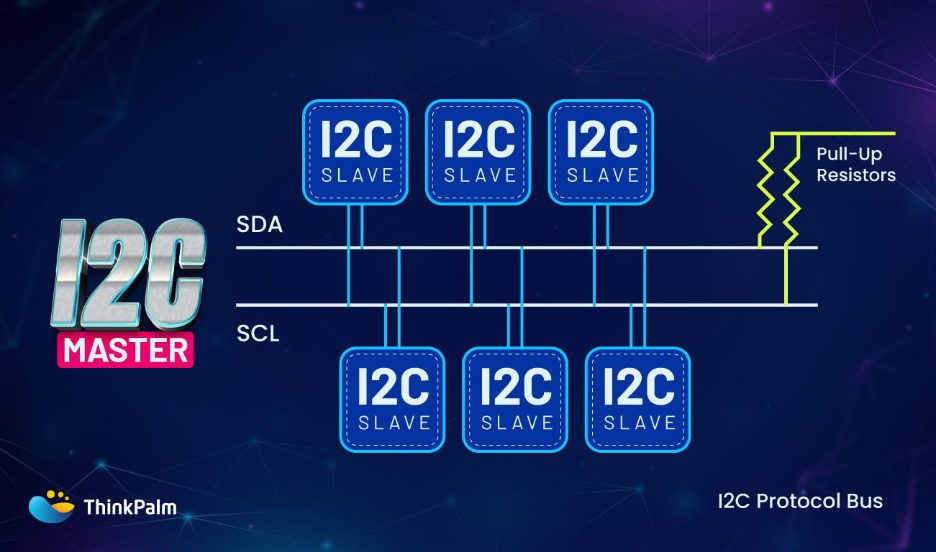
I2C Protocol Bus showing how a single master connects to multiple slave devices.
The jump from I2C to I3C brings many improvements in speed, power use, and how devices communicate. Because of this, the I3C vs I2C comparison shows how much communication has improved.
In addition, the I3C protocol vs I2C protocol also clearly highlights that modern devices work smarter and more efficiently with I3C.
To make this clearer, below is a simple table which shows the main differences!
| Feature | I2C | I3C |
|---|---|---|
| Speed | Up to 3.4 Mbps | Up to 12.5 Mbps and beyond |
| Power Use | Higher | Lower and more efficient |
| Addressing | Static addressing | Dynamic addressing |
| Interrupts | Extra wires needed | In-Band Interrupts (IBI) |
| Compatibility | Long-used; widely supported | Backward compatible + modern features |
| Use Cases | Basic sensors; simple systems | Advanced sensors; IoT; mobile; automotive |
When comparing the I3C protocol vs I2C protocol, it is easy to understand why most modern devices are shifting toward I3C. Furthermore, it is quicker, consumes less power, and can work with more sensors without any deceleration.
In addition, many of the limits that older systems such as I2C struggle with are also fixed by I3C.
I3C assists devices in communicating easily with simple wiring, smarter, and enhanced data rates. Consequently, this positions it as a powerful option for phones, wearables, cars, and other systems with many sensors.
Overall, I3C gives engineers a better, cleaner, and more future-ready way to build devices. In fact, it is not just an upgrade. It is the next step forward.
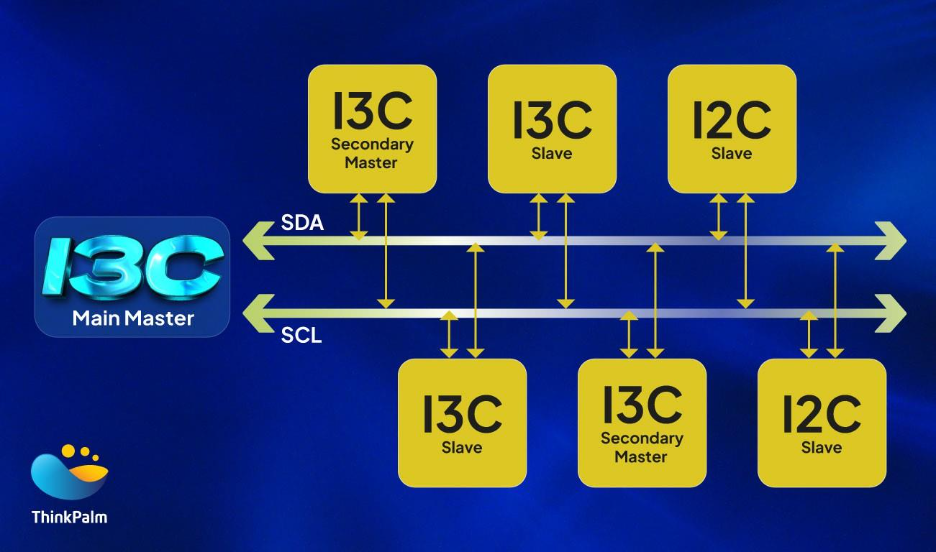
How I3C connects multiple masters and mixed devices on the same two-wire bus.
So, is your network ready for future demands in speed and stability? Get an inside look at how Multipath TCP overcomes the limits of standard TCP, supporting high-throughput, seamless connections for everyday devices.
One of the smartest features of the I3C protocol is dynamic addressing. To begin with, it completely changes how devices are identified and managed on the bus.
While older I2C devices use static addressing, which often leads to conflicts when many sensors share one bus, I3C uses dynamic addressing.
Consequently, this improvement is one of the main reasons behind growing I3C adoption across modern electronic systems.
The I3C protocol supports common command codes. In addition, these codes help devices share information more efficiently.
So, what is I3C doing differently from I2C protocols with dynamic addressing? To clarify, let’s check it out.
| Feature | I2C (Old Way) | I3C (New Way) |
|---|---|---|
| Device Addressing | Fixed 7-bit or 10-bit addresses set by the manufacturer | Devices have a unique identifier and get dynamic addresses automatically |
| Address Conflicts | If two devices share the same address, engineers must reconfigure jumpers or use multiplexers | No conflicts; controller assigns addresses dynamically at startup |
| Scalability | Adding new devices increases system complexity | Easily expands; supports dynamic bus management |
| Setup | Manual configuration required | Automatic address assignment using ENTDAA |
Summing up, all communication happens using these new dynamic addresses. This avoids addressing conflicts and makes device management much easier and faster.
Dynamic addressing in the I3C protocol brings several important benefits for modern devices:
Smartphones and wearables have many sensors, like accelerometers, gyroscopes, and light sensors. However, with the older I2C protocol, engineers often faced address conflicts and needed extra hardware.
Fortunately, with I3C’s dynamic addressing, each sensor gets a unique device address automatically at power-on. As a result, devices work smoothly, efficiently, and more reliably.
In addition, many new sensors are now I3C supporting, which makes it easier for companies to upgrade existing designs. Furthermore, even medical devices often require real-time data communication, which I3C handles efficiently.
Ever wondered what happens to a packet after it hits your device’s network card? Get a step-by-step look at Linux kernel internals and the packet-processing pipeline for embedded systems.
One of the most exciting features of the I3C protocol is In-Band Interrupts (IBI). This feature makes communication between sensors and controllers faster, simpler, and more efficient.
With I3C, sensors can alert the controller using the same two wires already used for data (SDA and SCL). As a result, this helps the controller respond quickly when receiving data from active sensors.
Here’s how it works:
Using In-Band Interrupts gives many benefits:
A smartphone motion sensor detecting sudden movement normally needs its own interrupt pin with I²C, and as a result, this adds many extra wires.
However, with I3C and IBI, the sensor sends the alert over the same two wires. Consequently, the controller responds instantly, making devices smaller, simpler, and faster.
Want to know how firmware helps devices communicate faster and more efficiently? Learn more about firmware’s role in modern embedded systems.
For businesses, adopting the I3C Protocol could bring many advantages by building modern devices. On the whole, with faster, simpler, and more efficient communication, businesses could help save time, reduce costs, and improve product performance. Besides, this can give system designers more flexibility and reduce engineering effort.
To begin with, here are the main benefits of I3C adoption.
| Benefit | What It Means |
|---|---|
| Lower Hardware Costs | Fewer pins, simpler PCB designs |
| Faster Time-to-Market | Easily scale with more sensors |
| Better Power Efficiency | Sensors and controllers use less power |
| Simpler Design | Cleaner boards with less wiring |
| Longevity | Standard for the next decade |
| Ecosystem Growth | Strong vendor support via MIPI Alliance |
| Future-Proofing | Ready for next-gen electronics and sensor-heavy devices |
Provided that, companies can build smarter devices more efficiently by switching to the I3C protocol. Indeed, this change also helps them reduce costs, design challenges, and long-term risks.
In general, the I3C protocol is becoming a key part of many modern devices. It helps sensors and processors talk to each other quickly, efficiently, and without using too much power.
Thanks to I3C adoption, industries are now able to build smarter, faster, and more reliable systems.
Here’s where MIPI I3C is making a difference:
With the I3C protocol, devices become smarter, designs stay simpler, and performance improves. This is why MIPI I3C is quickly becoming the standard for next-generation electronics.
Discover how MQTT and ESP8266-based systems enable real-time communication and instant device alerts across IoT environments.
On the positive side, the I3C protocol offers many advantages. But its adoption is still growing. In spite of its benefits, like any new technology, it comes with a few challenges to keep in mind.
Even with these challenges, I3C adoption continues to rise. As more companies and developers embrace the I3C protocol, the ecosystem will grow. This growth will make it stronger, more stable, and easier to use across industries.
The I3C protocol is changing how smart devices talk to each other. It takes the best parts of I2C and SPI and brings them together into one fast, flexible serial communication protocol. With growing I3C adoption, devices can now share data faster, use less power, and connect more easily than ever before.
Moreover, features like in-band interrupts, dynamic addressing, and hot-join support make I3C stand out in an I3C protocol vs I2C protocol comparison. Consequently, it can also help engineers build systems that are smaller, smarter, and ready for the future.
At ThinkPalm, we’re excited about what’s next. By exploring advanced technologies, we help businesses create connected solutions that perform better, scale faster, and stay ahead in a rapidly evolving tech world.

Padmapriyan R is a Senior Software Engineer passionate about embedded systems development. With hands-on experience in Embedded design, Communication Protocols, IOT and Networking. Currently focused on enhancing system stability, performance, and long-term product sustainability in embedded platforms.