Digital Signal Processing: What Is It & What Are Its Applications?

Artificial Intelligence
Vishnu Narayan June 15, 2023

In this digital world, signals that keep us connected are everywhere. But have you ever wondered how we make sense of them? That’s where ‘Digital Signal Processing (DSP)’ comes into play.   

It’s like a magical tool that uses math and computers to analyze and improve signals, and It’s what makes your favorite songs sound better and lets you talk to voice assistants.

In this article, we’ll explore the world of DSP, learn its fundamentals, and see the incredible things it can accomplish in our daily lives.   

Let us dive deep into the secrets of Digital Signal Processing and its cool applications!  

What Is Digital Signal Processing?  

Digital Signal Processing (DSP) is an amazing field that uses advanced math and computers to understand and improve signals. Signals are everywhere in our digital world, like music, pictures, and wireless communication.  

Imagine listening to music with headphones: DSP algorithms can remove all the unwanted background noise, making the sound much better and giving you an immersive experience while listening on your favorite headphones, earphones, and AirPods

Headphones

Not only that, but DSP also helps make pictures and videos look better by reducing fuzziness and making them clearer. Moreover, in wireless communication, Digital Signal Processing makes signals stronger and helps data travel faster.  

Using math and computer science, Digital Signal Processing makes a big difference in entertainment, communication, and science, making our experiences with sound and visuals even more awesome!  

How Does It Work?  

Digital signal processing (DSP) uses math to analyze and change digital signals. First, analogue signals become digital through sampling and quantization. Then, we use special tools to apply operations such as filtering, convolution, Fourier transforms, modulation, and coding. 

DSP improves signal quality, extracts information, remove noise, and compresses data. Moreover, if necessary, you can convert the processed signal back to its analogue form for further utilization or better human understanding.

Need more clarity? Don’t worry: Let’s dive deep and learn more about Digital Signal Processing in detail. As you read on, you’ll understand it better.  

What are Digital Signal Processing Fundamentals?

The Fundamentals of Digital Signal Processing (DSP) entail the basic concepts that help us understand and manipulate signals:  

  • Sampling: This is similar to taking snapshots of a continuous signal at regular intervals to create a digital replica. It’s similar to recording moments in a video to make individual frames.  
  • Quantization: It’s like assigning digital values to the measured analogue signal. Think of it as grouping the possible values into a finite set, just like rounding a number to the nearest whole number.  
  • Discrete Fourier Transform (DFT): This mathematical-based technique converts a discrete-time signal into its frequency domain representation. Also, it helps us understand the different frequencies present in a signal.  
  • Fast Fourier Transform (FFT): It’s an efficient algorithm that performs the DFT quickly. Moreover, it’s like a supercharged version of the DFT that helps us analyze signals faster and more effectively.  

To summarize, these fundamentals form the backbone of Digital Signal Processing, enabling us to analyze, manipulate, and extract valuable information from digital signals.  

What are the Key Concepts of Digital Signal Processing?  

The key concepts of Digital Signal Processing (DSP) encompass fundamental ideas for manipulating and enhancing signals. Let’s take a look.  

  • Filters: These are special algorithms that allow us to modify or obtain specific frequency components from a signal. Moreover, it’s like using a tool to separate different colors from a picture, focusing on the ones we want.  
  • Convolution: It’s a mathematical operation where two signals interact, resulting in a third signal that represents their combined effect. This is similar to mixing different ingredients to obtain a new flavor.  
  • Modulation: It is a method of transmission of data over a communication channel by encoding it onto a carrier signal. It is similar to encrypting a message to ensure its safe transmission.   
  • Noise Reduction: Using specific techniques to eliminate unwanted noise from a signal. It’s just like we have a noise-cancelling feature to remove unwanted background noise and let us focus on the important audio.  

To summarize, learning these key concepts in DSP empowers us to manipulate signals skillfully, extract desired information, and improve the quality of audio, images, and data transmission.

What are the Top Five Uses for Digital Signal Processing?

  • Audio Signal Processing: DSP is particularly useful in audio systems for tasks such as audio compression, equalization, and noise cancellation.  
  • Voice Processing: DSP has a vital role in voice-based applications such as voice assistants, voice-controlled systems, and voice communication.  

What are the Major Benefits of Digital Signal Processing?  

Digital Signal Processing (DSP) offers several advantages that have led to its widespread use. Let’s explore them: 
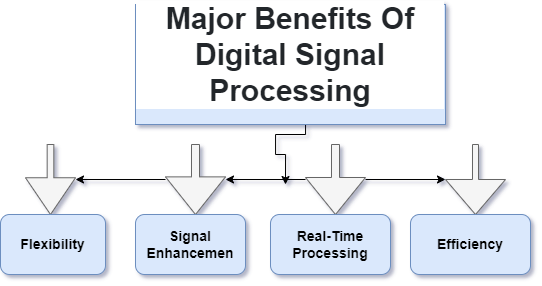
Major benefits of digital signal processing
  • Signal Enhancement: DSP algorithms can improve signal quality. They can reduce unwanted noise, enhance important details, and boost the overall quality of signals. Also, it’s like using a special filter to make a picture look clearer.  
  • Flexibility: DSP enables us to easily adjust algorithms to meet different signal-processing needs. Moreover, it’s as if having a toolbox with a variety of tools we can use for different tasks.  
  • Real-Time Processing: DSP can quickly process signals in real time, allowing analysis and manipulation as they occur. In addition, this is important for applications that require immediate responses, like video games or live audio processing.  
  • Efficiency: DSP techniques are designed to make the most efficient use of computing resources. In addition, they can execute complex calculations using less memory and processing power, making them efficient and effective.  

Why do Digital Signal Processors Matter? 

Digital Signal Processors (DSPs) perform digital signal processing tasks proficiently due because of their specialized microprocessor design. Moreover, they play a vital role across domains such as telecommunications, audio and video processing, radar systems, control systems, and more.   

Here are several reasons why DSPs matter: 

  • High-speed signal processing: DSPs are like super-fast calculators that process sounds, images, and other signals quickly and accurately.  
  • Specialized architecture: DSPs are designed for functions such as improving acoustic clarity, reducing noise, and enhancing picture quality.  
  • Real-time computation: DSPs operate at higher speeds and are beneficial for applications that run at high speeds, such as live video chats and streaming music or videos without delay.  
  • Power efficiency: DSPs are particularly designed to use less energy while still performing their tasks effectively, which is useful for battery-powered devices.  
  • Versatility: DSPs can be programmed to perform different tasks, enabling them to adjust to new technologies and improve over time.  
  • System integration: DSPs can perform many tasks on their own, such as converting signals from analogue to digital and vice versa, which helps make devices smaller and cheaper.  
  • Performance optimization: DSPs include built-in tricks and shortcuts to speed up and improve signal processing efficiency.  
  • Wide application range: DSPs are used in cell phones, Wi-Fi, music players, video games, medical devices, cars, and more, making them important across many areas of technology.  
  • AI processing: DSPs are essential for speeding up AI algorithms. Moreover, they are capable of managing the computing requirements of applications like speech recognition, natural language processing, computer vision, and deep learning. Similar to this, DSPs make it possible for AI-powered applications and devices to perform tasks more quickly and precisely, boosting user experiences and enabling new capabilities such as robotics, virtual assistants, and self-driving systems.  

End Note  

In conclusion, Digital Signal Processors (DSPs) are the secret powerhouses behind our favorite devices, making them work faster, smarter, and more efficiently.  

At ThinkPalm, we provide top-notch AI services that enable you to explore the full potential of Artificial Intelligence, creating mind-blowing technology experiences. 

Moreover, our mission is to convert your wildest tech dreams into an astonishing reality. We dedicate ourselves to making the seemingly impossible possible through leveraging our expertise and latest technologies.  

So, are you ready to witness the AI wizardry of ThinkPalm? Connect with our AI experts today and receive the exceptional AI development services that’ll enable you to leverage the unlimited possibilities of AI. 


Frequently Asked Questions

1. What is digital signal processing?

Digital signal processing (DSP) is a set of techniques to make digital communications more accurate and reliable. Also, it works by clarifying or standardizing the levels or states of a digital signal.

2. What are the applications of digital signal processing?

Various fields such as acoustics, structural testing, video processing, geophysics, automotive and aerospace engineering, energy, medical imaging, RADAR, SONAR, and LIDAR utilize digital signal processing.

3. Where do people mainly use digital signal processors?

Embedded digital signal processors find applications in various consumer products, including mobile phones, fax/modems, disk drives, radios, printers, medical and healthcare devices, MP3 players, high-definition televisions (HDTV), and digital cameras.

AI is the future - Powerful AI Services


Author Bio

Vishnu Narayan is a dedicated content writer and a skilled copywriter working at ThinkPalm Technologies. More than a passionate writer, he is a tech enthusiast and an avid reader who seamlessly blends creativity with technical expertise. A wanderer at heart, he tries to roam the world with a heart that longs to watch more sunsets than Netflix!