AI in Architecture Design: How Agentic AI Is Shaping Modern Software Systems
Agentic AI
 Midhula Jeevan
March 19, 2026
Midhula Jeevan
March 19, 2026



 Midhula Jeevan
March 19, 2026
Midhula Jeevan
March 19, 2026
Let’s start with a simple scenario. Imagine a software project that begins with a clear goal and strong business intent. But after a few months, the system struggles to scale, new features take longer to build, and performance issues begin to surface. Often, the root cause is not the code. It is the architectural decisions made at the very beginning.
This is where AI in architecture design can make a real difference.
As today’s software systems become more complex, interconnected, and continuously evolving, making the right architecture decisions early becomes critical.
What This Blog Covers
AI in architecture design helps teams make smarter software design decisions early in the development lifecycle. By using agentic AI and enterprise AI agents, teams can build systems that scale better, reduce risks, and adapt as requirements change. This leads to faster delivery and more future-ready software systems.
Read on as we explore how AI supports software architecture design within the software development lifecycle and helps teams build scalable and future-ready systems.
Architecture design is the blueprint that transforms abstract software requirements into concrete, scalable systems. It defines how components interact, how data flows between services, and how the system is structured to handle growth over time.
Think of it like building construction. An architect usually considers structural integrity, user flow, future additions, and so on when putting up a building. Similarly, software architects map out how components interact, how data flows across services and systems, and how the system evolves as it grows over time.
At its core, architecture design includes the definition of modules, their relationships, and the pattern of communication. This involves database, API, and security levels, and deployment strategy decisions.
The task of an architect has been the balancing of performance, maintainability, cost, and speed to market. However, that is a job that is evolving today. As the agentic AI architecture is becoming more sophisticated, manual design decisions are no longer the only approach teams rely on.
Requirements can now be analyzed, the appropriate patterns can be suggested, and architecture diagrams can also be generated by intelligent tools. Such a change can prevent costly errors within teams and bring the knowledge of architecture into daily development workflows.
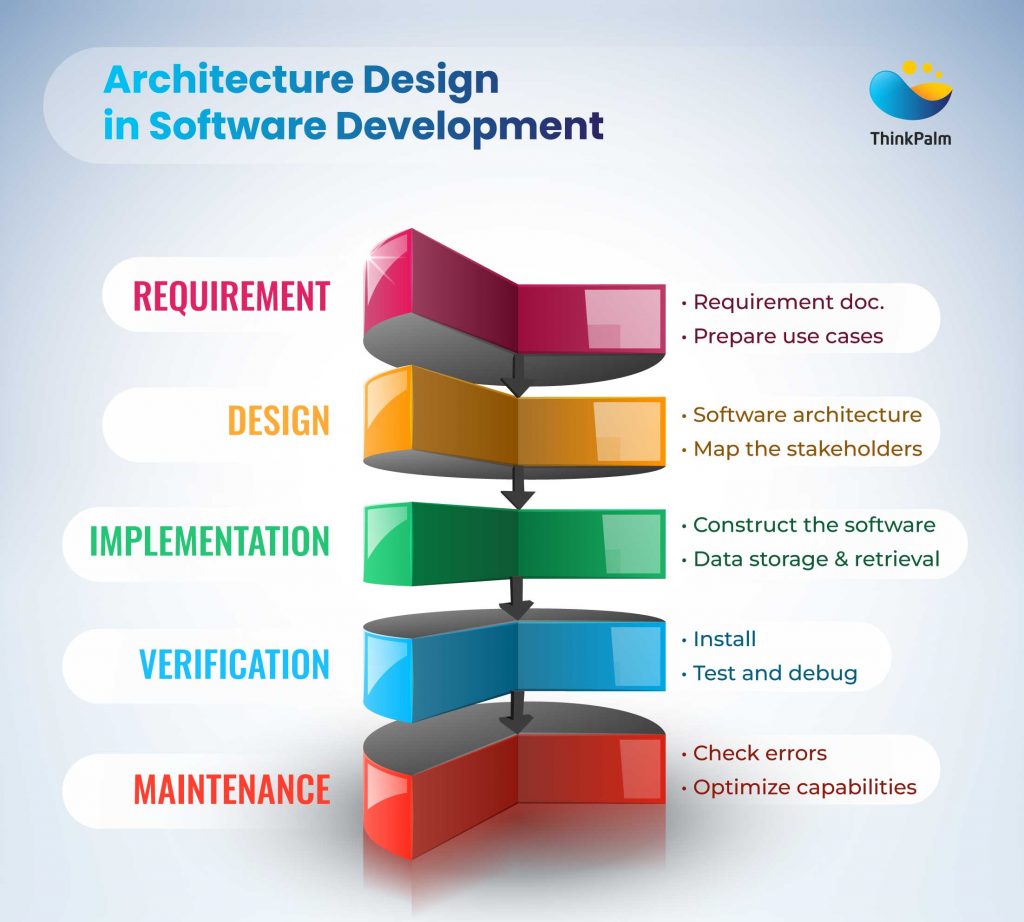
The core phases of software architecture design within the development lifecycle.
To understand how these architecture decisions carry forward into development and delivery, explore how Agentic AI in SDLC helps automate and improve every phase of software delivery.
AI in architecture design is the application of artificial intelligence in designing software systems. Rather than merely relying on manual work and experience, AI can go further into the needs, constraints, and objectives of the project.
The best thing being the fact that it gives the appropriate architecture, which comprises of styles, components, and design patterns.
Enterprise AI agents are at the center of this process. They understand both business and technical needs. The agents simplify the process by inspecting things such as the features of the system, performance requirements, and scalability objectives, as well as compliance policies. They propose an architecture after a thorough analysis that promotes long-term growth and smooth system operation.
It is no secret that by adding intelligence early in the design stage, AI can help teams make better decisions, reduce guesswork, and build software systems that are easier to manage and improve over time.
So, how does AI improve architecture design in SDLC? The first thing it does is help teams make better design decisions early, before even starting the development. It analyses requirements, system constraints, and business goals to guide architecture choices.
By using artificial intelligence in software development, you can select the right architecture patterns and reduce design risks. As the project evolves, AI updates its recommendations, helping teams build systems that stay flexible and easy to maintain.
When looking into the AI architecture design process, the industry is reaching a major turning point. In recent decades, manual design processes have rapidly given way to intelligent, automated systems.
In traditional architectural design, human intuition and experience are relied upon. While it could produce remarkable results, it was indeed a time-intensive approach. Furthermore, it struggled to keep pace with modern project demands. This is where AI-driven approaches are beginning to transform the design process.
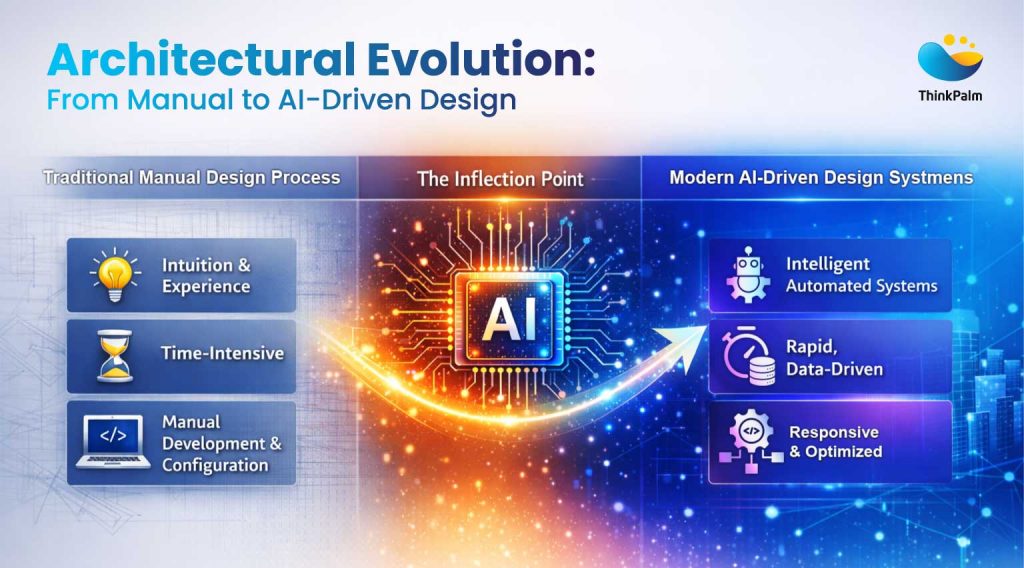
The evolution of software architecture from traditional manual design to modern AI-driven architecture systems.
The goal of AI in architecture is to change the landscape of development today, as it offers capabilities that have never been considered before. Where architects once spent weeks manually exploring design options, AI can now evaluate thousands of configurations in a fraction of that time.
The positive aspect is that all these could be optimized against specific system requirements like performance targets, scalability needs, and security constraints.
Gensler’s 2026 Design Forecast notes that the adoption of AI technologies is becoming a necessity for firms that want to gain a competitive edge in an ever-more intricate design environment. While this observation comes from the world of physical design, the same truth applies to software architecture.
This is not merely a change of speed. It is also focused on the opening of new creative opportunities that arise when the creativity of humans is enhanced by computational power.
Looking at the aspect of transitioning into AI architecture design, it is not only the adoption of technology. It also indicates a paradigm shift in the role of the architect as an individual creator to one acting as a collaborative conductor.
Orchestrating AI capabilities alongside traditional design expertise may help achieve outcomes that neither could accomplish alone.
Now, let’s take a look at how architecture design using artificial intelligence works. The agentic AI architecture relies on a set of intelligent agents that collaborate in creating software systems.
Rather than a single AI doing everything, there are a number of enterprise AI agents specializing in various components of the architecture. Every agent will examine the system in a particular manner and contribute to improved design decisions.
Here’s how enterprise AI agents work in architecture design:
If we strip it down to basics, agentic AI architecture helps teams move from basic static design decisions to flexible and evolving architectures.
Want to understand the basics behind these intelligent agents? Read our detailed guide on what is Agentic AI and see how AI agents think, decide, and work together in real-world systems.
As mentioned above, the application of AI in architecture design introduces intelligence to one of the most significant phases of software development. With AI-driven architecture design, teams can minimize the guesswork and eliminate the problems at the earliest stage.
Below are some of the key capabilities of using AI architecture design, which help to build systems that are easier to scale, secure, and maintain.
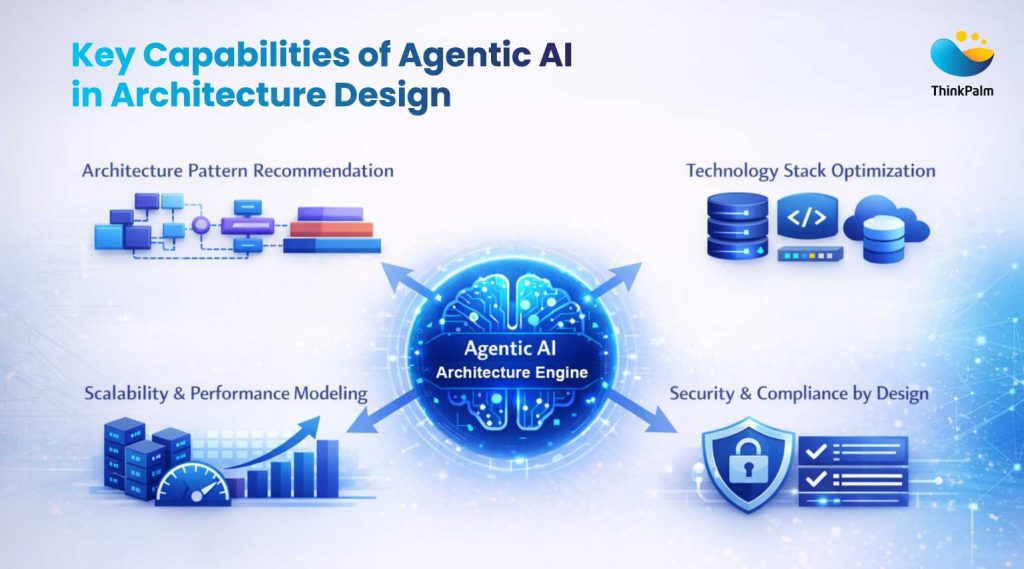
Core functions of an Agentic AI architecture engine supporting modern software system design.
The selection of architecture pattern is paramount to success in the long run. Under AI architecture design, agentic systems interpret system requirements and propose those patterns that are applicable to the use case.
With agentic AI architecture, AI agents propose patterns like microservices, event-driven systems, or layered architecture according to complexity, scale, and performance objectives.
This will help teams avoid overly complex designs and choose patterns that are, in fact, in support of the system.
The choice of the appropriate technology stack may be somewhat challenging at the current time due to the numerous tools and frameworks on the market.
Enterprise AI agents make this easier by considering project needs and system limitations.
With AI architecture design, agents suggest appropriate programming languages, frameworks, databases, and cloud services. This, in turn, makes sure that the technology stack is in tandem with the system architecture and the long-term business needs.
Modern systems evolve continuously, and to handle growth without performance degradation is critical. AI-driven architecture design helps teams plan for scalability and performance early in the design stage.
By using AI architecture design and multi-agent system architecture, different AI agents focus on load handling, response times, and resource usage.
Together, they predict how the system will behave under stress and suggest design improvements to support future growth.
Security should not be an afterthought. With AI architecture design, security and compliance are built into the system from the beginning.
Using AI architecture models, AI agents identify security risks, suggest secure design patterns, and ensure compliance with industry standards. For example, they can flag designs where sensitive data passes through unsecured API endpoints, identify components that lack proper access controls, or highlight areas that do not meet standards like GDPR, HIPAA, or SOC 2.
Fixing vulnerabilities at the very end of the development stage is costly and time-consuming. A proactive approach helps teams reduce issues and build safer software systems.
The benefit of AI-driven architecture design lies in its ability to help the team make smarter architecture decisions. By bringing intelligence into the design stage, AI architecture design reduces uncertainty and supports better long-term outcomes.
Key benefits of AI in architecture design include:
To put it clearly, AI-driven architecture design helps teams move from reactive fixes to proactive planning.
When architecture decisions are supported by AI, everyday workflows also become faster and more efficient. Learn how AI workflow optimization helps teams unlock better productivity.
Choosing the right approach to architecture design can shape the success of a software system. AI in architecture design brings intelligence and speed to early decisions. On the other hand, traditional methods depend mostly on manual analysis and experience.
Understanding this difference helps teams see how to use AI in architecture design to build stronger and more adaptable systems.
| Aspect | Traditional Architecture Design | AI-Driven Architecture Design |
| Decision-making | Based on manual analysis and past experience | Uses AI-driven architecture to analyze data and suggest designs |
| Speed | Slower due to manual reviews and iterations | Faster with automated insights and recommendations |
| Scalability planning | Often planned later in the project | Built early using AI in architecture design |
| Handling complexity | Harder to manage as systems grow | Better handled through AI-driven analysis |
| Adaptability | Changes require redesign and rework | AI updates recommendations as needs change |
| Consistency | Depends on individual expertise | More consistent through AI-driven standards |
The table above with the comparison shows how AI-driven architecture helps teams design systems that are more flexible as well as ready for the future.
ThinkPalm assists companies to directly introduce AI in architecture design into their software development lifecycle. We treat architecture as a continuous and evolving process rather than a one-time activity.
Using intelligent AI agents, an agentic AI architecture provides assistance to the architects and development teams at all levels. Such agents examine requirements, propose appropriate architecture patterns, and match design decisions with business and technical objectives. With the development of the systems, AI keeps improving its suggestions to aid scalability, performance, and security.
By embedding AI-driven architecture design in SDLC, ThinkPalm enables teams to build software systems that are flexible, reliable, and ready for future growth.
The future of software systems depends on making smart design decisions early. AI in architecture design is changing how teams plan, build, and scale modern applications. With AI-driven architecture, organizations can move faster, reduce risks, and build systems that are ready to grow.
Agentic AI architecture takes this a step further by using enterprise AI agents that work together to guide architecture decisions over time. These agents adjust as needs change and help teams build systems that stay reliable, secure, and efficient.
As software systems become more complex, AI in architecture design will play a bigger role in successful development. If you want to see how agentic AI can support your architecture design journey, get in touch with ThinkPalm and start the conversation.
The architecture decisions made with the help of intelligent agents are guided by agentic AI. These agents break down requirements, evaluate trade-offs, and propose designs that will change with the project life cycle.
AI-driven architecture design plans for growth early by predicting load, performance, and system behavior. This helps teams build systems that scale smoothly without major redesigns.
AI in architecture design speeds up decisions, reduces design risks, and improves consistency. It also helps teams build scalable and future-ready systems from the start.
Yes, AI in architecture design works well for legacy systems too. It helps analyze existing setups and suggest improvements without a complete rebuild. This supports safer and gradual modernization.
Midhula Jeevan is a passionate content writer with a focus on SEO and technical writing. With a love for words and a curiosity for the technical side, she blends creativity with strategy to craft content that stands out. When not writing, you could find her usually reading books, enjoying a good cup of coffee, or chasing golden sunsets.