 Vipin Nair
November 26, 2026
Almost every organisation I speak to says it is doing agentic AI. Look closer, and most are using a chat tool and calling it a strategy. That is not a criticism. It is a starting point. The problem is not where you are. The problem is not knowing where you are and trying to jump three levels in one budget cycle.
This is exactly where an agentic AI maturity model helps.
Simply put, an agentic AI maturity model shows how far your organisation has moved from chatbots to agentic AI that takes action within clear limits. Compared with a general AI maturity model, it offers a sharper view, because it focuses on how much work AI agents can safely do, and who stays accountable.
Over the last year at ThinkPalm, we have built AI into shipped products, internal platforms and client proofs of concept. Each one sat at a different level, and each needed different foundations. This guide shares the six-level model we use internally to place a use case, decide what must exist before we build it, and set honest expectations with clients.
You will find the levels, the evidence you need to move up, the safety controls that matter, how the main frameworks compare, and a quick self-check. You can also take our AI maturity assessment to find your starting point.
Want to know your level before you read on?
Take our AI maturity assessment to evaluate where you stand and identify opportunities to advance your AI adoption.
Take the AI Maturity Assessment →Definition
An agentic AI maturity model is a structured framework for judging how consistently an organisation can put AI agents to useful, controlled work.
It describes progressively stronger capabilities, so teams can see their position, the gaps that matter, and the evidence needed before expanding. Microsoft’s framework, for example, combines five maturity levels with five capability pillars.
It helps to know how this differs from related models:
For practical use, keep three questions separate: what the agent can do under test (capability), what it may do without approval (autonomy), and whether the business can operate and govern it consistently (organisational maturity).
A successful demo should never, by itself, authorise broader production access.
At ThinkPalm, we use a six-level Agentic AI Maturity Model internally to assess how AI capabilities evolve, from basic assistance to advanced autonomous workflows. This framework helps us evaluate the level of autonomy, human involvement, governance, and orchestration across different AI use cases, while identifying the capabilities needed to progress further.
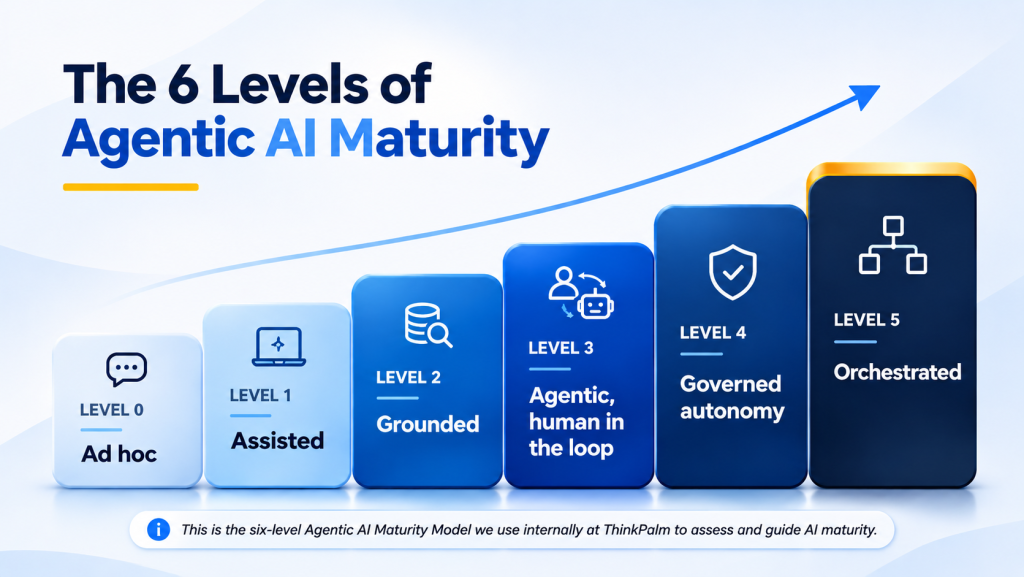
| Level | Name | What It Looks Like | ThinkPalm Example | Foundation Needed |
|---|---|---|---|---|
| 0 | Ad hoc | People use public chatbots on their own. No company data, no governance. | Where most teams start | Usage policy, approved tools |
| 1 | Assisted | AI is a feature inside a product: summarise, draft, transcribe. People act. | PBXAI call transcription, sentiment and summaries | Product integration, privacy controls |
| 2 | Grounded | AI reads your data through controlled retrieval and cites its sources. | Pensions member data assistant, built in about two weeks | Clean data access, citations, role-based access |
| 3 | Agentic, human in the loop | Agents call tools and propose actions. People approve, reject or enrich. | Data centre RCA agent across BMS, EMS and alarm systems | Tool contracts, approval flows, feedback loop |
| 4 | Governed autonomy | Low-risk decisions run automatically within policy. The rest route by risk tier. | Finance controls platform with four review tiers | Rules engine, routing, audit, evaluation harness |
| 5 | Orchestrated | Many agents across systems, continuously evaluated, run as a product. | The target state for most enterprises | AgentOps, cost control, model lifecycle management |
People use public chatbots on their own, with no company data and no governance. Staff may paste sensitive information into unapproved tools, and nobody can see it.
AI becomes a feature inside a product, and people still take the action. Our PBXAI voice AI overlay transcribes calls, shows sentiment and writes summaries, using generative AI and a large language model (LLM) for one narrow job.
Here the AI reads your data through controlled retrieval and shows which records it used. Our pensions member data assistant is a RAG assistant that went from design to a working build in about two weeks. This is where enterprise intelligence begins, because the AI works from your governed knowledge instead of guessing from training data.
AI agents call tools and propose actions, and people decide. In our data centre root cause analysis agent, an alarm triggers the agent, which pulls context from building, energy, fire and video systems. The data centre head approves, rejects or enriches the finding, and that decision feeds the next run. These agentic workflows are where trust is built.
Low-risk decisions now run on their own, inside policy, while higher-risk ones are routed for review. In finance control platforms, decisions are divided into four tiers: automatic, review, mandatory individual review, or human approval. Agents explain and match, rules decide, and people approve. This is the first level where an autonomous workflow runs without a person approving every step.
Many specialised agents work across systems, run as a product. Multi-agent systems at this level need orchestration, shared memory, continuous evaluation and cost control. Few organisations are here today, but it is the target state for most enterprises.
A level tells you where you are today. The capability pillars tell you why, and what to fix to move up. Organisations rarely grow evenly, and your weakest pillar sets your ceiling. Excellent data access with no audit trails, for example, keeps you at Level 3 at best.
A clear strategy for enterprise AI agents, an executive sponsor and outcomes you can measure
Who owns the results, and how will we know it worked?
Clean, governed access to the records and documents agents need
Can our AI reach the right data, and only the data it should?
Tools, integrations and architecture that fit your current stack
Can agents connect to our systems safely and reliably?
Rules, guardrails, audit trails and clear decision rights
Can we show what an agent did, and who approved it?
Who builds, approves, runs and retires agents, often through a center of excellence (CoE)
Who is responsible for each agent after it goes live?
Training, change management and clear roles for people working beside agents
Do our people know how to work with agents, and when to step in?
Use these pillars as a checklist. The pillar where you answer least confidently is the one to fix first.
It is rarely the model. The same LLM can sit behind a Level 1 feature and a Level 4 workflow. What changes is everything around it.
A common mistake is to treat autonomy as a switch. In reality, human oversight changes shape at each stage. Three oversight modes cover most cases:
A person approves each important action before it happens. This is the safest mode but the slowest.
The agent acts within policy while a person monitors, reviews by risk tier and can step in. Sensitive decisions stay with people.
The agent acts and people audit afterwards. Use this only for low-risk decisions that are easy to reverse.
A single workflow often moves through all three: approvals during a pilot, monitoring as trust grows, and unattended runs only for its lowest-risk steps. The right question is not how to remove people. It is which decisions need a person, and where.
As autonomous systems take on more work, the controls around them must grow too. These are the measures we put in place first:
An organisation that has never grounded AI in its own data should not give autonomous AI agents write access to its ERP. Every level builds the muscle the next one needs.
Our pensions proof of concept reached a working build in about two weeks because it targeted four specific use cases, in the client’s own order of risk, starting with the lowest.
Our principle is simple: rules first, AI where rules run out, people where it matters. AI explains, matches and ranks. People own the outcome.
Most organisations do not know which level they belong to when they approach us, so we take a progressive journey:
Learn how people already use AI, set approved tools and privacy boundaries, then add focused features such as summaries or call transcription.
Assess data quality and access controls, then add controlled retrieval, such as a RAG assistant with citations and role-based access.
Choose clearly defined agentic workflows, set tool permissions and add human approval.
Find decisions that can run safely without individual approval, then add policy-driven decision engines, risk-based routing, audit trails and evaluation.
Add central orchestration, monitoring, cost controls and model lifecycle management, so AI runs as a governed capability instead of scattered projects.
Not every organisation needs to reach Level 5. We begin with a maturity assessment, find processes with measurable potential, check data and technology foundations, and prioritise a practical proof of concept. The result is a phased roadmap with measurable milestones. For the wider business view, read our guide to enterprise AI agents.
Because enthusiasm is not a strategy. WWT reports that Gartner predicts more than 40% of agentic AI projects will be cancelled by the end of 2027. The causes are familiar: skipping levels, no clear measure of success, agents that sit beside workflows instead of inside them, and weak controls.
A maturity model gives leaders, IT, security and the business one shared language. Track a few simple measures: adoption, the autonomy ratio (the share of steps finished without human intervention), cycle time, decision quality, monthly cost per workflow, and governance exceptions. They show when a workflow has earned more autonomy, and when to pull it back.
The goal of an agentic AI maturity model is not to reach Level 5 everywhere. It is to know where you stand, build the next foundation, and give AI agents only as much autonomy as your controls can support.
Vipin Nair is a Technical Project Manager and AI Lead at ThinkPalm Technologies, where he drives AI strategy and delivery for clients across the UK, US and Singapore. Over 15+ years he has delivered enterprise software in payroll, maritime, device security and IoT. He now focuses on agentic AI, helping organisations assess where they stand and move from early pilots to systems that hold up in production. He stays hands-on, architecting and building proofs of concept himself. Vipin is a Microsoft Certified Azure Solutions Architect Expert and Azure AI Cloud Developer Associate, and writes regularly on agentic AI and architectural patterns.
One message is all it takes to get started. Tell us what you need, and we’ll take it from there, no long forms, no waiting around.

