How ThinkPalm Delivered 50% Faster Payroll Implementation with AI
Overview
A leading UK-based provider of payroll and HR solutions was faced with severe hurdles such as payroll delays, compliance risks, and error-prone calculations. They needed a way to deliver faster, smarter, and future-ready payroll services to their customers. Partnering with ThinkPalm helped them achieve 50% faster results, higher accuracy, and lower costs.
Embedding AI into every stage of the software development lifecycle (SDLC) enabled ThinkPalm to provide a solution that modernized and accelerated the implementation of its Automated HR/Payroll (AHP) services.
With this transformation using intelligent automation, in AHP the company streamlined payroll processing. This enhanced the compliance, accuracy, and the overall efficiency of its HR services. Moreover, the company was able to reaffirm their position as a trusted market leader in simplifying payroll and HR management.
This case study examines the key business challenges and how ThinkPalm’s tailored AHP solution helped achieve significant speed and efficiency gains compared to traditional methods.
The Challenge
The traditional payroll and HR systems had to face severe challenges such as:
- Long development cycles and delayed time-to-market
- Manual, error-prone payroll calculation processes
- Poor scalability and lack of modern API architecture
- Limited flexibility for evolving compliance and payroll rules
- High development and maintenance costs
Requirements
The company needed a solution that would:
- Deliver a modern, intuitive, and responsive UI.
- Provide a scalable API-driven architecture.
- Reduce development costs and errors.
- Ensure rapid implementation without compromising quality.
Solution: AI-First Approach
ThinkPalm adopted an AI-first execution model to accelerate every phase of the software development lifecycle (SDLC). Intelligent automation and AI-driven insights were applied at each stage, ensuring 50% faster delivery, higher accuracy, and a scalable, future-ready payroll platform. Here are the key stages where AI was implemented:
1. AI-Enhanced Requirements Elicitation
- Converted high-level business problems into functional payroll modules using AI tools for brainstorming decomposition approaches and validating module breakdowns while respecting confidentiality and data privacy.
- Identified implicit rules, dependencies, and corner cases through AI-assisted analysis of existing documentation and structured stakeholder questioning.
- Generated domain insights from historical payroll practices by leveraging AI to synthesize patterns from legacy system documentation and business rules.
- Enhanced requirement documentation using AI for structured formatting, validation checklists, and stakeholder-friendly summaries.
Practical Results
✓ Clearer requirements with improved structure and completeness
✓ Reduced change requests through more thorough upfront analysis
✓ More accurate early deliverables with better system understanding
✓ Faster review cycles with AI-generated documentation summaries
2. AI-Enhanced Sprint Planning
- Auto-generated user stories and epics from requirements using AI tools to draft story templates and suggest functional breakdowns.
- Created detailed acceptance criteria by leveraging AI to generate comprehensive checklists and edge case scenarios.
- Suggested sprint planning and dependency management through AI analysis of story relationships and sequencing.
Practical Results
✓ Faster conversion of requirements into sprint-ready backlog.
✓ More comprehensive acceptance criteria covering missed edge cases.
✓ Improved sprint planning with AI-suggested groupings and dependencies.
3. AI-Enhanced Architecture Design
- Recommended Clean Architecture principles using AI tools to validate design decisions and suggest modular structure approaches for maintainability.
- Suggested Strategy Pattern for payroll rule management through AI analysis of varying business logic (fixed, variable, accrual, zero-day) and extensibility requirements.
- Defined service boundaries and abstraction strategies with AI assistance in evaluating layering approaches and identifying potential coupling issues.
- Identified potential compliance or payroll risks at an early stage through AI insights.
Practical Results
✓ Scalable architecture ready for future extensibility with validated design patterns
✓ Clear separation of concerns enabling easier testing and maintenance
✓ Well-defined boundaries supporting independent module development.
4. AI-Enhanced UI/UX Design
- Translated Figma mockups into reusable Vue JS components using AI tools to generate initial component code and structure from design specifications.
- Proposed fallback/error handling UI for edge cases through AI analysis of common failure scenarios and user experience patterns.
- Suggested optimized layouts for mobile and tablet performance with AI assistance in responsive design recommendations and component optimization.
Practical Results
✓ Faster stakeholder reviews with demo-ready UI components
✓ Comprehensive error handling improving overall user experience
✓ Responsive design ensuring consistent performance across devices
5. AI-Enhanced Coding with strict code privacy protection
- Generated Python scripts for payroll logic prototypes using AI tools to quickly validate business rules and test data assumptions before C# implementation.
- Using Python workflow code as a blueprint, AI-assisted the creation of .NET DTOs, interfaces, and repositories, ensuring Clean Architecture consistency and best practices.
- Real-time code reviews for naming conventions and structure with AI-powered suggestions for code quality and consistency improvements using privacy-enabled configurations to prevent third-party model training.
- Generated Karate automation tests leveraging AI that uncovered corner cases early, preventing issues from surfacing in later stages.
Practical Results
✓ Shorter coding cycles with early validation minimizing rework.
✓ Reduced bugs through AI-assisted code quality checks and pattern guidance.
✓ Business-aligned logic with validated prototypes before final implementation.
6. AI-Enhanced Testing
- Auto-generated unit and integration test cases using AI tools to create comprehensive test suites from functional logic descriptions and business requirements.
- Suggested mocking strategies aligned with architecture through AI assistance in identifying dependencies and recommending appropriate mocking approaches.
- Built edge-case validations to enhance coverage with AI-generated test scenarios that addressed corner cases often missed in manual testing.
Practical Results
✓ Reduced manual testing effort with comprehensive automated test generation
✓ Higher confidence in production readiness through robust test coverage
✓ Enhanced quality output with fewer post-deployment issues.
7. AI-Enhanced Deployment (Planned)
- AI-enabled deployment strategies were designed to streamline CI/CD pipelines and automate build-test-deploy workflows.
- Implementing rollback automation with AI assistance in monitoring deployment health and triggering recovery processes.
Expected Results
✓ Seamless rollouts with reduced manual intervention
✓ Faster recovery and reduced downtime during deployments.
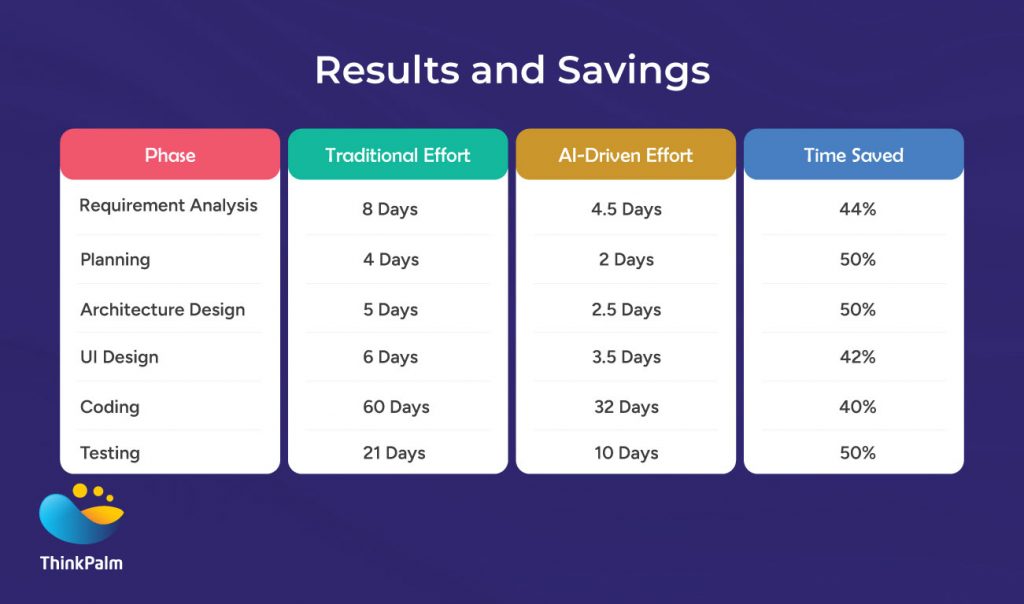
Results and Savings
Customer Benefits
1. Accelerated Time-to-Market
Faster release cycles with AI-supported automation.
2. Higher Accuracy
AI-driven validation minimized payroll errors.
3. Reduced Costs
Lower development and testing overheads.
4. Future-Ready Platform
Clean, modular architecture supporting extensibility.
5. Enhanced User Experience
Responsive, intuitive UI designed with AI support.
Conclusion and Next Steps
ThinkPalm’s AI-first approach to Automated HR/Payroll (AHP) delivery has already proven how intelligent automation can cut SDLC efforts by nearly half, accelerate time-to-market, and ensure higher accuracy at lower costs.
Looking forward, ThinkPalm plans to extend AI’s role into deployment, predictive payroll forecasting, AI chatbots for employee payroll queries and self-optimizing payroll accuracy that will set the standard for future-ready HR and payroll platforms. This approach positions the AHP platform to evolve into a smarter, more adaptive, and intelligent ecosystem that grows alongside changing business and compliance needs.
Where could you save 40–50% in your software lifecycle?
Every organization has untapped efficiency waiting to be unlocked. Let’s explore how our AI-first model can be tailored to your business.
Let's Get To Work
Contact us and we'll have one of our experts reach out to you and discuss how we can lead your project to success.