
























Accelerating Wi-Fi Certification with Pre-Certification Testing
Explore how ThinkPalm helped a Wi-Fi Alliance certification candidate catch issues early with pre-certification testing against the Sigma framework.
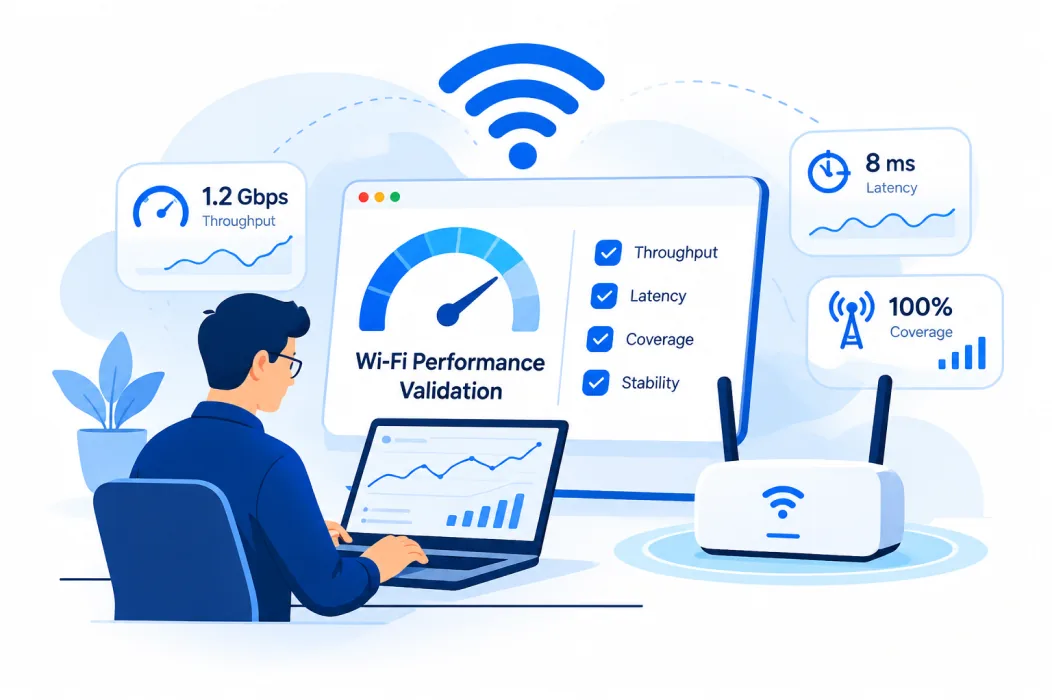
Whether you design Wi-Fi chipsets, build routers and mesh systems, or deploy gateways at scale, a missed defect means delayed launches, failed certification, and costly returns. ThinkPalm’s Wi-Fi device testing services validate your silicon, devices, and CPE against the conditions they will actually face, on lab infrastructure built for Wi-Fi 6, 6E, and Wi-Fi 7.

Field issues seldom appear without warning. They usually point to testing gaps that should have been caught before launch.
Go beyond basic functional testing with validation that uncovers performance gaps, connectivity issues, interoperability challenges, and compliance risks before they become field problems.
01/09
Get your device checked against Wi-Fi Alliance certification requirements before submission, so issues are fixed early, and your launch stays on track.
Your device is tested against
Wi-Fi Alliance and TR-398 requirements using Candela and LANforge.
Each failure is mapped to a specific requirement, with clear guidance for remediation.
Fixes are re-tested and results documented to support your formal submission.
Start with a pre-compliance assessment before you submit to the certification lab.
Start My Pre-Compliance CheckThinkPalm offers TR-398 testing to validate Wi-Fi access point performance against industry requirements. Our testing setup evaluates performance, stability, coverage, and sensitivity across key scenarios. Using automated workflows with tools such as Candela and LANforge, we identify implementation-level gaps, map failures to relevant TR-398 requirements, and support targeted remediation and re-testing before certification.
Validate Wi-Fi devices against TR-398 Issue 2 test requirements across 802.11n, 802.11ac, and 802.11ax (Wi-Fi 6), covering the 2.4 GHz and 5 GHz bands.
Extend TR-398 validation to Wi-Fi 6E (802.11ax) and additional performance scenarios introduced with Issue 3.
From Raw Test Data
to Certification-Ready Reports
See how test outcomes are documented to specific TR-398 requirements.
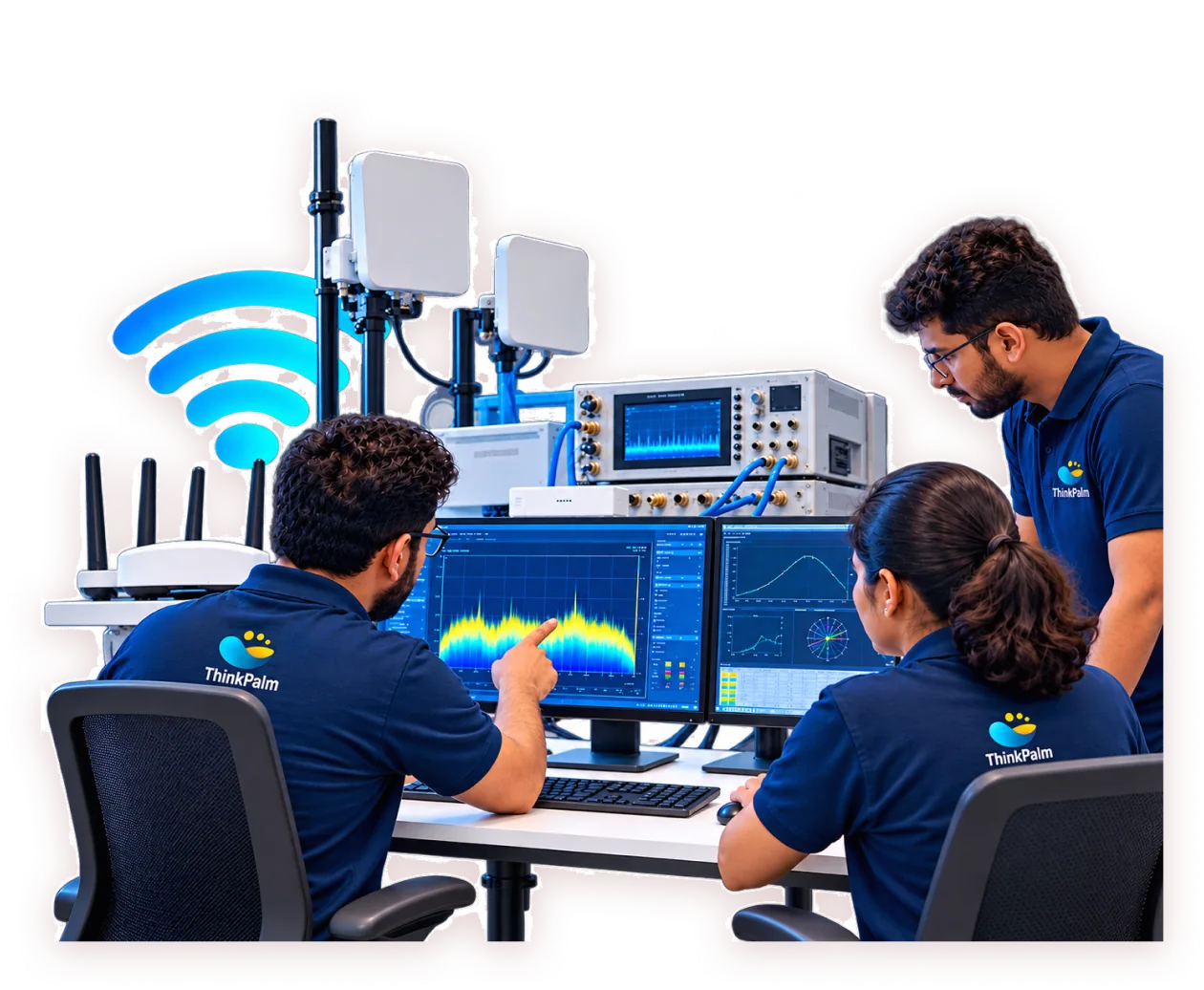
See how our Wi-Fi lab combines controlled test environments and real-world scenarios to validate your devices before launch.
Hybrid and conducted throughput and roaming tests.
Over-the-air testing for Wi-Fi 6E and Wi-Fi 7 across 2.4, 5, and 6 GHz.
Client emulation and range vs. throughput testing.
Coexistence and interoperability with Bluetooth, Zigbee, and cellular.
Automated RF calibration from 400 MHz to 7.3 GHz.
Real-world device testing, free from urban interference
A closer look at how this testing has played out for device manufacturers and network providers.
Explore how ThinkPalm helped a Wi-Fi Alliance certification candidate catch issues early with pre-certification testing against the Sigma framework.
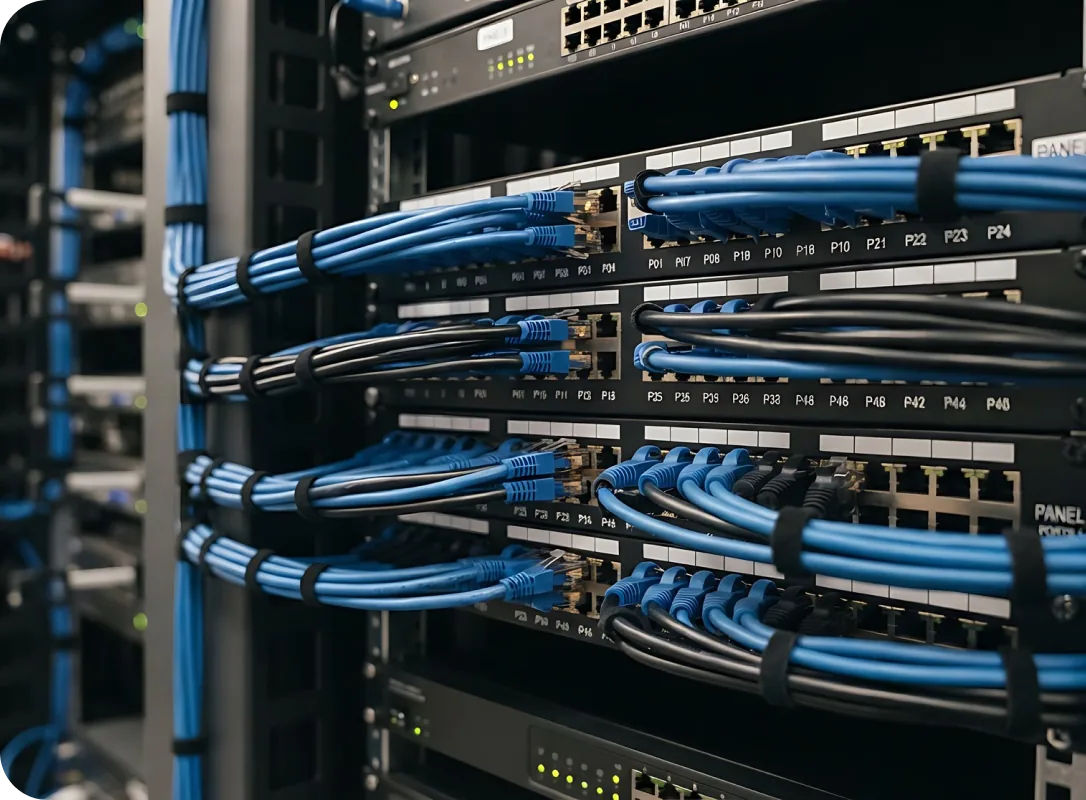
A Wi-Fi device manufacturer needed its gateways, routers, mesh systems, and extenders validated for real-world roaming behavior before launch.
See how ThinkPalm assessed a new Wi-Fi access point for a networking OEM using Rate-vs-Range-vs-Orientation testing ahead of formal pre-compliance submission.
From the first assessment to final sign-off, you know what’s being tested, where things stand, and what happens next.
Your device, target market, and testing priorities are assessed to define the scope and requirements.
A tailored test plan is created to cover the relevant test areas, standards, and environments.
Testing is carried out in the required environment using real client devices and access points.
Identified issues are documented with clear reproduction steps and severity levels for faster resolution.
Fixes are verified, and relevant tests are rerun to confirm that identified issues are resolved.
A comprehensive summary of test results and findings is provided to support your device’s market readiness.
Move from testing to certification with fewer delays, using purpose-built labs, automated test cycles, and Wi-Fi validation expertise.
More than 16 years in the telecom sector, with long-standing clients across the UK, EU, USA, Asia, and the Middle East who rely on us for wireless validation.
Get practical insights from engineers who understand the challenges that can affect Wi-Fi performance, reliability, interoperability, and certification.
Test your devices in controlled and realistic environments designed to uncover issues across different stages of product development.
Keep validation moving with repeatable automated testing that helps identify issues earlier and reduces the effort of testing every firmware build.
Wi-Fi device testing and validation checks how a device actually performs, once RF interference, multiple client devices, roaming, and everyday firmware changes are added to the picture. It covers performance, stability, interference, mesh and extender behavior, feature validation, security, automation, and configuration/customization testing, so issues are caught on the bench rather than after a customer sets the device up at home.
TR-398 is the Broadband Forum’s industry-standard Wi-Fi access point performance test plan, covering throughput, coverage, receiver sensitivity, and stability. ThinkPalm runs TR-398 Issue 2 (802.11n/ac/ax, Wi-Fi 6) and TR-398 Issue 3 (extended coverage for Wi-Fi 6E, including latency-under-load, QoS, and multi-band testing) using automated workflows with Candela and LANforge.
Pre-compliance testing is an internal readiness check, run against Wi-Fi Alliance and TR-398 requirements before formal submission, so failures are mapped to specific requirements and fixed on our bench. Wi-Fi Alliance certification is the official process carried out by an accredited test house; pre-compliance testing reduces the risk of surprises once your device gets there.
Yes. Our lab infrastructure, including an anechoic chamber covering 2.4, 5, and 6 GHz, is built for Wi-Fi 6, 6E, and Wi-Fi 7 devices, and Feature Testing verifies Multi-Link Operation (MLO), OFDMA, and MU-MIMO where applicable, so Wi-Fi 7 devices can be validated now rather than waiting on lab upgrades.
Performance testing benchmarks a single device’s throughput, range, and coverage. Mesh & Extender Testing specifically validates roaming, handoff, backhaul, and band-steering behavior across multiple nodes, including self-healing after a node failure and interoperability across mixed hardware, the failure modes that only surface once several nodes are deployed together.
One message is all it takes to get started. Tell us what you need, and we’ll take it from there, no long forms, no waiting around.